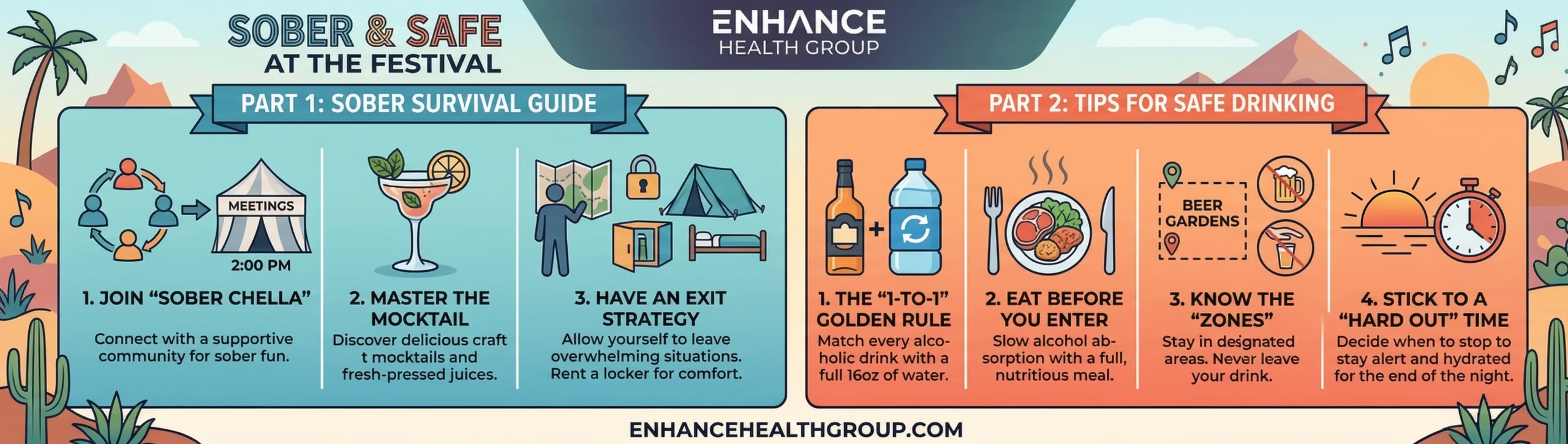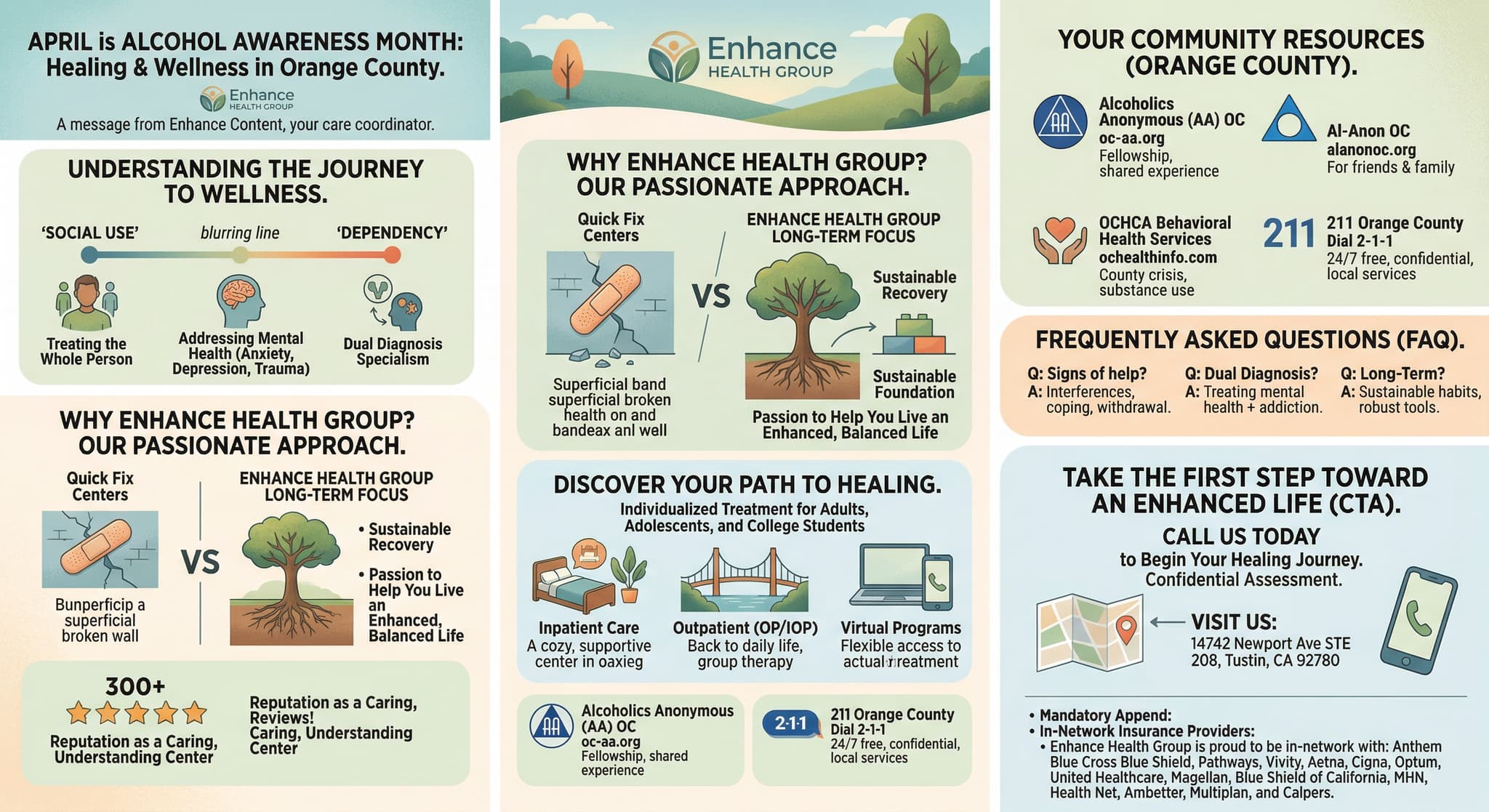
Sober holiday activities work best when you plan them before the invitations pile up, and Orange County in December gives you plenty to choose from, like morning beach walks, neighborhood light displays, and volunteer shifts. You don't have to white-knuckle your way through the season or skip every gathering. A few specific plans, made now, keep your calendar full of things you'll actually want to show up for.
If you're thinking about hurting yourself or feel unsafe, call or text 988 right now.
Sober Holiday Activities That Work in Orange County This December
The plans that hold up best share three traits: they happen in daylight or early evening, they have a built-in end time, and they give your hands and attention something to do. That's why a Saturday morning hike at one of the regional parks in the hills east of Tustin tends to go better than an open-ended night out. You know when it starts, you know when it finishes, and nobody is handing you a drink.
Think in categories, then fill in dates. Outdoor options include a walk along the sand at sunrise, a bike ride on the Santa Ana River Trail, or a drive to see neighborhood light displays with a thermos of something warm. Service options include volunteering at a food pantry or helping sort donations, which gives you a role and a shift schedule instead of a room full of small talk. Creative options include a cookie-decorating afternoon at your place, a pottery class, or a board game night where you pick the guest list.
Before you commit, ask yourself two questions about each plan. Who else will be there, and can you leave without explaining yourself? If the answer to the second is no, find another way to get there, such as driving your own car, so you're never stuck.
Put two or three of these on your calendar this week, and text a friend to join you for at least one. A plan with another person attached is much harder to talk yourself out of at 4 p.m. on a tired day.
Plans for the Parties You Can't Skip
Some gatherings come with obligations, like the office party, your in-laws' Christmas Eve dinner, or a family reunion where everyone has known you for decades. For these, the plan matters more than the guest list. Decide three things before you walk in: how you'll get there, what you'll be holding, and how you'll leave.
Drive yourself, or arrange a ride you can cancel. Once you've arrived, grab a sparkling water with lime or a mug of cider right away, because a full glass in your hand answers the question "Can I get you something?" before anyone asks it. Most hosts won't push back, and a short line works well when someone does: "I'm good with this, thanks." You don't owe anyone a reason.
Pick one person at the event who knows you're staying sober. That could be a sibling, a spouse, or a friend who's also invited. Agree on a signal or a text, so you have someone to step outside with if the room gets loud or a relative starts pouring drinks near you.
Give yourself a time limit, and tell the host you can stay for dinner but need to head out by a certain hour. Leaving on schedule feels very different from leaving because you're about to cave. If the evening goes sideways, you can step out for ten minutes, call someone, or go home without apologizing.
If a particular gathering feels like too much, skipping it is a legitimate choice. Send a warm note, drop off a dish earlier in the day, or visit the person the following week over coffee.
Why December Can Hit Harder Than Other Months
Most of the pressure in December comes from stacking, not from any single event. Work parties, school breaks, travel, family dinners, and year-end reflection all land within about five weeks, and many of them come with alcohol as the default. Your normal routine of regular sleep, regular meals, and regular check-ins with people who support you usually gets squeezed at the exact moment the triggers multiply.
Grief and loneliness are part of it too. A holiday table with an empty chair, a strained relationship with a parent or ex, or a first season without drinking can bring up feelings you've been managing quietly the rest of the year. Shorter daylight can pull mood down for people with depression or anxiety, and those symptoms and substance use tend to feed each other.
Some signs that the season is getting heavier than a calendar can handle:
- You're sleeping much less or much more than usual for more than a week.
- Cravings are showing up daily, or you're bargaining with yourself about "just one" event.
- You're canceling plans with supportive people and saying yes to the risky ones.
- Low mood, panic, or irritability is making ordinary tasks hard to finish.
If you recognize two or more, that's a good reason to talk with a professional rather than wait for January. Co-occurring depression, anxiety, or trauma alongside substance use is something Enhance treats under dual diagnosis care, and a clinician can sort out which symptom is driving which. Asking early doesn't commit you to anything. It gives you information about what level of support fits.
Building a Week-by-Week Plan Before the Holidays Start
Four weekly anchors will carry you from the first of December through New Year's Day, and each one takes about ten minutes to set up. Write them on a paper calendar or in your phone, and share them with whoever is your support person.
Week one is for routines. Pick a fixed wake-up time, schedule three meals, and book one standing check-in each week, whether that's a recovery meeting, a therapy appointment, or a Sunday phone call with a friend. These are the habits December squeezes first, so protect them before anything else goes on the calendar.
Week two is for travel and guests. If relatives are flying in or you're flying out, sort out where you'll sleep, how you'll get around, and who you'll text when you land. Staying in a hotel instead of a relative's guest room is a reasonable choice if the house keeps alcohol out on the counter.
Week three is for the heaviest stretch, usually the days around Christmas and Hanukkah. Plan something for every evening that has historically been hard, even a small one like a movie, a walk, or dinner with a friend who doesn't drink. Empty evenings are where cravings tend to fill the space.
The final week is for the turn into the new year. New Year's Eve is built around a midnight toast, so decide early whether you'll host a mocktail gathering, join a sober event, or be in bed by ten. Then schedule something for January 2, so the season ends with a next step instead of a drop-off.
Check in with yourself at the end of each week. If you've missed your anchors twice running, treat that as a reason to call someone, not a reason to push harder alone.
When a Calendar Isn't Enough Support
If you've followed your plan and still feel cravings most days, or you've had a slip and can't tell whether it's a one-off, you're likely past what scheduling can fix. That isn't a failure of willpower. It usually means the level of support needs to change, and Orange County has several steps between a weekly meeting and a hospital stay.
Enhance runs a partial hospitalization program (PHP) and an intensive outpatient program (IOP) at the Tustin center, so you can keep sleeping at home while getting structured treatment. Outpatient therapy is also available by video through virtual treatment, which helps if travel and family obligations make driving to appointments hard. If depression, anxiety, or trauma is tangled up with drinking or drug use, dual diagnosis treatment addresses both together instead of treating one and hoping the other settles.
Some people need more than daily visits. If you can't stay sober at home, or withdrawal is a risk, detox and residential care are provided at Embrace Treatment Center (embracetreatment.com), a sister facility of Enhance. Mental health inpatient care is at Eden by Enhance (edenbyenhance.com). You'd start with Enhance admissions either way, and they'll help you work out which fit makes sense.
If the cost is the worry, ask about it before you decide against help. Enhance is in network with many major plans, including Anthem Blue Cross Blue Shield, Aetna, Cigna, and Covered California, and benefits vary by plan. Admissions checks yours and explains what your plan may cover.
Calling doesn't commit you to anything. You can ask what each level of care involves and whether the holidays should change your timing. Many people find that having an answer in hand, even a tentative one, makes the rest of December feel more manageable.
What Happens When You Call Enhance
The call goes to the admissions team at the Tustin office, and the first few minutes are mostly questions about you. Expect to be asked what's been going on, what you're using or feeling, how long it's been happening, and whether you've had treatment before. You don't need a polished answer. "I've been drinking more since Thanksgiving and I'm scared of what December looks like" is enough to start.
It helps to have a few things nearby, though none of them is required to call:
- 1Your insurance card, if you have one, so admissions can look up your plan.
- 2A rough list of any medications you take.
- 3The names of any therapists or doctors you've seen recently.
If you want to know what your plan may cover, admissions contacts your insurance company, then walks you through your deductible, your copay, and which level of care your plan may cover. If you'd like to go forward after that, the same team handles the next step with you.
The admissions team will also talk with you about which level of care sounds right, whether that's an outpatient program, PHP, IOP, dual diagnosis care, or a referral to a sister facility. You can tell them about the holiday dates that worry you most, like a family trip or a party you can't skip, and they'll factor those into the conversation. Nothing you say on the call locks you into a program, and your information stays private.
If you'd rather start online, the verify insurance form on the admissions page sends your details to the same team.
When you're ready, call (714) 862-1907 and tell them where you are in your plan.