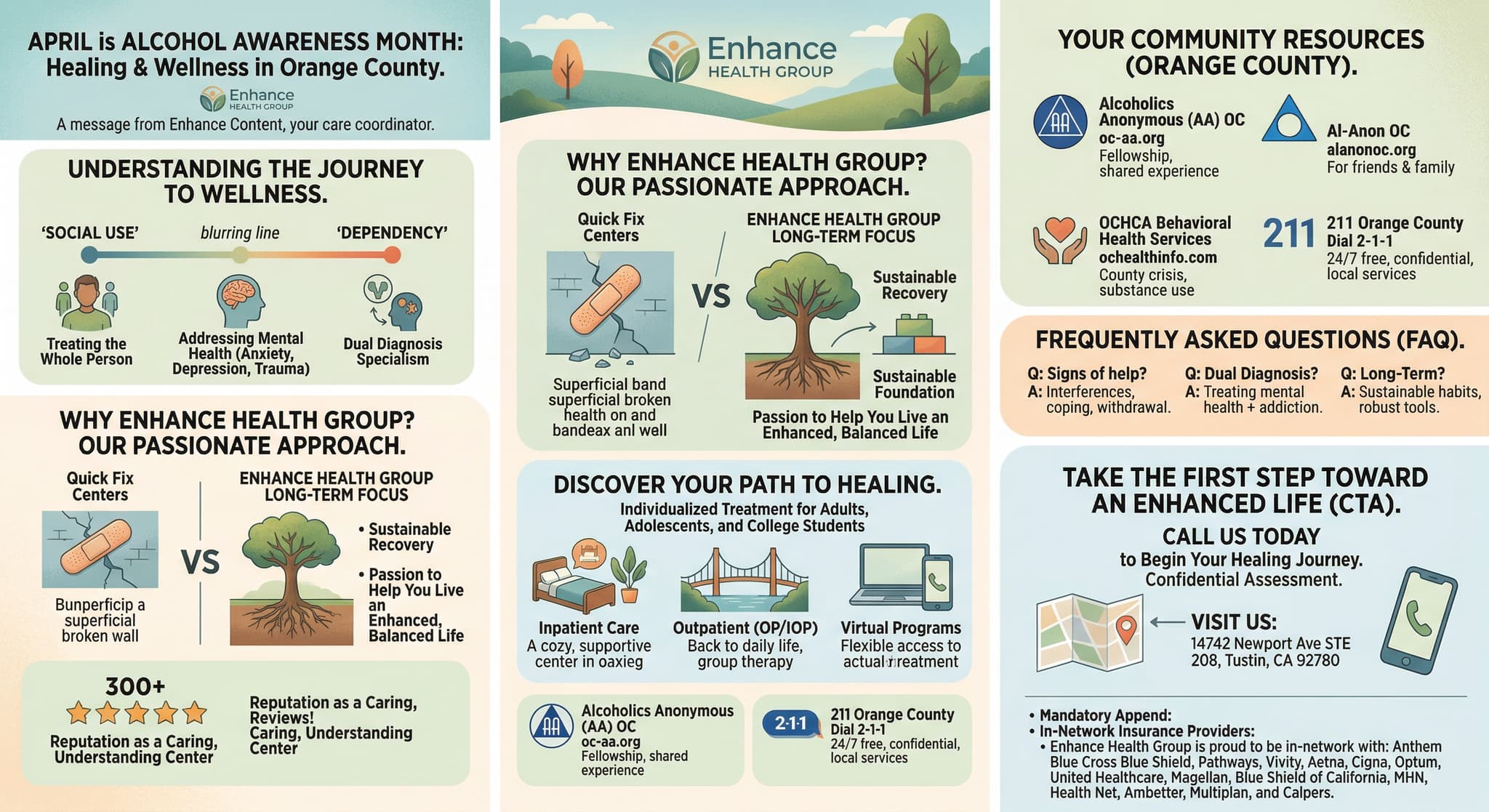
If you've started wondering whether someone's drinking has crossed a line, April is a natural time to say so out loud, and you don't need a crisis to start that conversation. If you're worried about yourself or a person you love, the Tustin team at Enhance Health Group can talk through what you're seeing and which level of care fits.
If you or someone you love is thinking about suicide or is in immediate danger, call or text 988 right now. For alcohol withdrawal with seizures, confusion, or chest pain, call 911.
What Alcohol Awareness Month Means for Your Family in Orange County
Alcohol Awareness Month is a good moment to look at drinking the way you'd look at any other health habit, with a calendar nudge and no blame attached. Most families we talk with don't call because of one dramatic night. They call after months of small things adding up, like a parent who's started drinking alone at lunch, a spouse who hides bottles, or a college student who can't get through a weekend without a hangover that wrecks Monday.
April also tends to be when people say out loud what they've been noticing. A neighbor mentions a check-in, a workplace sends a reminder, or a school posts a link. If that nudge reaches you, treat it as permission to ask a plain question: is alcohol costing this person something at work, at home, or in their health?
You don't have to answer that alone, and you don't have to be certain before you reach out. For general facts on alcohol use and how it affects the body, the National Institute on Alcohol Abuse and Alcoholism is a reliable place to read. For free, confidential referrals at any hour, SAMHSA's National Helpline is 1-800-662-4357.
When you're ready for a local conversation, our admissions team in Tustin will ask what you've noticed, how long it's been going on, and whether there's anything else in the picture, such as depression, anxiety, or trauma. Drinking and mental health often travel together, and we treat both under one plan through our dual diagnosis care. Have your insurance card nearby if you can, though the call doesn't require one.
Signs That Drinking Has Moved Past a Habit
The clearest sign is that the drinking keeps happening after it has already caused a problem. Someone gets a DUI, misses a shift, or argues with a spouse about it, and within a week they're drinking the same way again. A habit bends when it costs something. Alcohol use that has become a problem tends to hold its ground.
Other signs show up in the body and the schedule:
- Needing more drinks to feel the same effect than they did a year ago
- Shaking, sweating, nausea, or trouble sleeping on mornings after heavy drinking, or when they go a day without
- Drinking earlier in the day, or alone, or hiding how much
- Trying to cut back, promising to, and not managing it
- Dropping things they used to care about, such as a sport, church, or time with friends
Withdrawal deserves special attention. If someone who drinks every day stops suddenly and starts shaking, sweating, or seeing things that aren't there, that's a medical situation. Quitting cold on their own can be dangerous, and supervised detox exists for exactly this reason. Detox takes place at our sister facility, Embrace Treatment Center, and Enhance admissions is still the first call, so we can help sort out what's needed.
You also don't need to see every item above. One or two that keep repeating, especially alongside low mood, anxiety, or a history of trauma, is enough reason to ask a professional for an assessment. Our clinicians include master's and doctorate-level therapists, and the first conversation is about what's happening in daily life, not about labeling anyone.
If you're checking yourself, ask whether you'd drink less if you could, and whether you've tried. If you're watching someone else, write down what you've seen with dates, like missed work, a scary drive, or a changed mood. Specific notes make the next conversation easier to have, and they help an admissions counselor understand where to start.
Raising It With Someone You Love Without Starting a Fight
Pick a time when the person is sober, rested, and not about to leave for work, because a talk that starts mid-argument or the morning after a bad night usually ends in a slammed door. A quiet moment in the car or on a walk often works better than a sit-down at the kitchen table, since nobody has to hold eye contact.
Start with what you've seen and how it's landed on you. "I noticed you missed Sunday dinner twice this month, and I've been worried" is much harder to argue with than "You drink too much." Use the dated notes you've been keeping, but offer one or two examples, not a full list. A stack of evidence feels like a trial.
Expect some pushback. Many people say they're fine, that everyone drinks, or that you're overreacting, and that's a normal first answer, not a final one. You don't need to win the point. Try saying, "You don't have to agree with me. Would you be willing to talk to someone just to see?" An assessment is a conversation, and agreeing to one doesn't sign anyone up for a program.
Some things tend to backfire:
- Pouring out bottles or hiding keys without telling them
- Bringing up the problem while they're intoxicated
- Ultimatums you aren't ready to carry out
- Gathering the whole family without warning
If the talk goes badly, you can try again in a week or two. You can also call us yourself before they're ready. Our admissions team at 14742 Newport Ave in Tustin can explain what an assessment involves, walk you through next steps, and help you plan what to say, and you don't need the person's permission to ask for guidance.
Levels of Care, From Detox to Virtual Outpatient
Treatment for alcohol use runs along a ladder, and the right rung depends on how much medical support someone needs and how stable home is. Your first conversation with admissions helps sort that out, so you don't have to guess in advance. Enhance is Joint Commission accredited and holds California Department of Health Care Services certification 300410AP.
Detox comes first for someone whose body has become dependent on alcohol and who needs supervised withdrawal. Residential care follows for people who need a structured place to live while they build early recovery. Both happen at our sister facility, and Enhance admissions coordinates the first step.
Most of what we run in Tustin is the step-down work. A partial hospitalization program (PHP) is the most intensive option where you go home in the evening, with several hours of therapy on treatment days. An intensive outpatient program (IOP) asks for less time, which makes it easier to keep a job or care for kids. For people who need a structured place to live while attending PHP or IOP, supported living homes offer staff oversight.
Virtual outpatient is the lightest level. Sessions happen by video, so a long commute or a packed workday doesn't have to stand in the way, and it works well as a step down after a higher level of care.
Mental health symptoms change the picture. If depression or anxiety is driving the drinking, dual diagnosis care treats both together, and a person who needs round-the-clock psychiatric support may be referred to Eden by Enhance for inpatient mental health care.
Nobody has to commit to one level forever. The clinical team reassesses as someone progresses, and people often move down a level as they stabilize. Ask admissions how your plan treats each level, since benefits vary by plan and the team can check what yours may cover.
What Happens When You Call Enhance Admissions
A person on the admissions team answers, and the first few minutes are mostly listening. They'll ask who the care is for, what you've noticed, how long it's been going on, and whether anything else is in the picture, such as low mood, panic, or past trauma. You don't need a diagnosis or a perfect timeline to answer. "He's been drinking every day since March and he's scared to stop" is plenty to work with.
If you want to move faster, have a few things within reach:
The insurance card, or the plan name and member ID
Any medications the person takes now
Notes on recent episodes, with dates, if you've been keeping them
Whether there's been a hospital visit, a DUI, or earlier treatment
None of it is required for the call, and the team will work with whatever you have.
Benefits get checked while you talk. Admissions contacts your insurance company, then explains the deductible, the copay, and which level of care your plan may cover. Benefits vary by plan, so the team lays out what your plan shows rather than guessing. We work with plans including Anthem Blue Cross Blue Shield, Aetna, Cigna, Optum, United Healthcare, Blue Shield of California, MHN, Health Net, Ambetter, Multiplan, CalPERS, and Covered California.
From there, the team suggests a level of care and explains why. If you decide to continue, admissions walks you through the next steps with you, and you're free to ask questions or say you need a day to think it over. Calling doesn't commit you to anything.
You can also use the form on our admissions page if talking on the phone feels like too much right now. To reach a person, call (714) 862-1907, or verify your insurance online and the Tustin team will follow up.
Common Questions
Is it okay to call if I'm not sure my drinking is a problem?
Yes, you can call with that exact question. Many people reach out because they're curious or uneasy, not because they've decided anything. An assessment looks at how alcohol fits into your daily life, sleep, mood, and relationships. You'll leave the conversation knowing whether treatment makes sense, what other options exist, and what a reasonable next step would be.
Will my employer or family find out if I get treatment?
Your treatment information is kept private, and sessions are confidential. In general, the people who learn about your care are the ones you choose to tell, along with your clinical team and your insurance company for billing. If you're worried about work, ask admissions how scheduling works at each level of care, since some options leave more room for a job than others.
Can I get treatment for alcohol and anxiety or depression at the same place?
Yes, our clinicians treat drinking and mental health symptoms together under one plan. Alcohol can make anxiety, low mood, and trauma symptoms worse, and those symptoms can push someone to drink more. Treating only one often leaves the other in place. During your first conversation, mention any panic, sadness, sleep trouble, or past trauma so the team can factor it in from the start.
What if the person I'm worried about refuses to get help?
You can still get support for yourself and plan your next move. Admissions can talk with you about what you're seeing, how to bring it up again, and what to say if they become ready. Many people need a few conversations before they agree to an assessment. Looking after your own sleep, stress, and boundaries matters too, since living with someone's drinking is hard.
Does Alcohol Awareness Month change anything about how treatment works?
No, treatment works the same way in April as in any other month. The month is a prompt to start the conversation, not a special program or deadline. If you've been thinking about reaching out, you don't need to wait for a particular date, and you don't need to wait until things get worse. The Tustin team can talk with you whenever you're ready.