
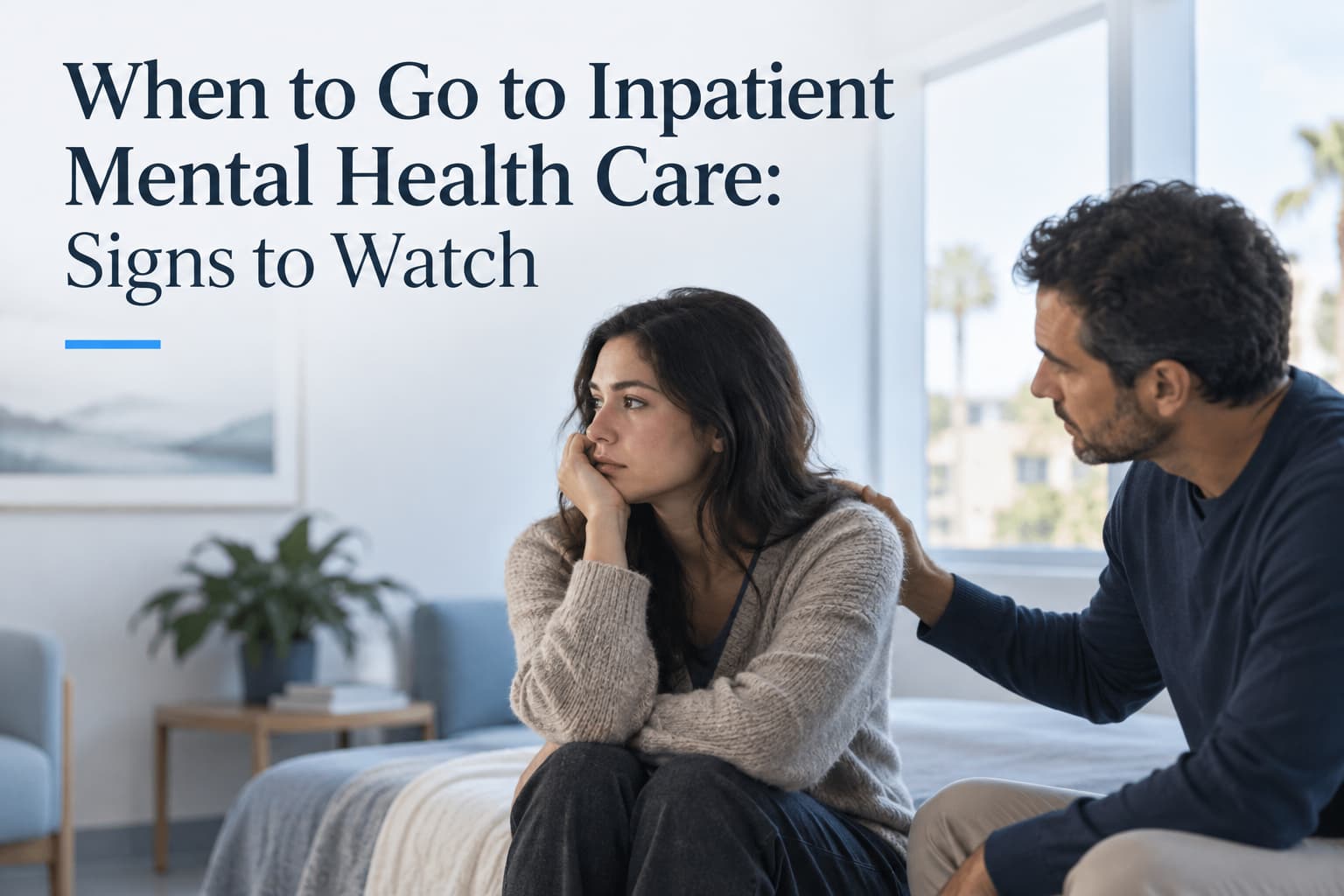
If you can't stay safe at home, even with a day program and people checking in, inpatient mental health care is the safer choice. That usually means thoughts of ending your life with a plan or the means nearby, or symptoms so severe that you can't handle basic daily needs. A partial hospitalization program (PHP) sends you home each evening, and inpatient care doesn't.
If you're thinking about suicide or you're worried about someone who is, call or text 988 now. If anyone is in immediate danger or has taken something harmful, call 911.
When to go to inpatient mental health care instead of PHP
PHP works when your home can hold you between sessions. You attend a structured day program at our Tustin center, at 14742 Newport Ave STE 208, go home in the evening, and have a bed, a door that locks, and someone who can notice if the night goes badly. If any of those three are missing, the plan has a hole in it.
A few questions help sort it out. Think about whether you can keep the means of harm out of reach, such as medications, firearms, or alcohol. Consider whether an adult in the house can stay with you, not just check in by text. Notice whether you've been getting through the evenings and weekends, or whether those are the times your symptoms spike. If the honest answers are no, no, and not really, a day program asks more of your home than your home can give.
Clinicians also look at direction. Someone who has been slowly improving in PHP and hits a bad week is in a different place than someone who is getting worse each day despite attending. Stepping up to a higher level of care is a normal clinical decision, and it isn't a failure of the program or of you.
Inpatient mental health care is delivered at Eden by Enhance, a sister facility of Enhance owned and run by the same people. You can read how that level of care works on our inpatient mental health page, and Eden's own site is edenbyenhance.com. Enhance admissions stays your first contact, so you don't have to work out which door to knock on.
Our clinicians make the call on level of care after an assessment, and they'll explain their reasoning in plain terms. Having someone outside the situation look at it can be a relief, especially if you've been second-guessing yourself for weeks.
Signs that point to inpatient rather than a day program
Some signs are clear enough that a family shouldn't wait for the next PHP session to act on them. The most direct is a suicide plan paired with access to the method, especially if the person has rehearsed it, set a date, or given belongings away. A plan with a timeline calls for round-the-clock supervision, and a day program can't offer that.
Other signs are less dramatic but point the same way:
- Self-harm that's escalating, or new injuries that need medical attention.
- Not eating, drinking, or sleeping for days, to the point that basic health is slipping.
- Hearing or seeing things that aren't there, or believing things that frighten them and can't be talked down.
- Missing PHP sessions because they can't get out of bed, or attending but being unable to take part.
- Mixing alcohol or drugs with their symptoms in a way that's making each worse. Dual diagnosis care addresses both, and a clinician can tell you whether a higher level of care fits.
Pay attention to what happens after a session ends. If your loved one leaves group calm and then unravels by nine o'clock, or if a medication change has left them sedated, agitated, or confused, the trouble is in the hours when no clinician is present. That pattern is the strongest practical argument for a setting where staff are there overnight.
Past treatment matters too. Someone who has already tried a day program or outpatient therapy and keeps sliding backward may need a stay long enough to stabilize first, with PHP as the step down afterward.
You don't need to be certain before you call. If two or three of these sound familiar, tell our admissions team what you're seeing, and a clinician will assess where your loved one needs to be. Enhance is Joint Commission accredited, and the assessment happens through our Tustin team before any level of care is recommended.
What an inpatient stay involves
Most people expect an inpatient stay to look like a hospital ward, but the first day is mostly assessment. A clinician talks with you about what led up to the stay, what you've been taking, what you've tried before, and what feels most dangerous right now. A psychiatrist reviews your medications, and the team decides what you need first, whether that's sleep, stabilizing a medication change, or getting through the worst of a crisis.
Bring a list of current medications with doses, the name of your outpatient prescriber or therapist, and your insurance card. If you're helping a family member, write down what you've noticed and when it started. Staff can use those details to build the plan faster than they can from a single conversation with someone who is exhausted or frightened.
Days are structured around treatment. Expect individual time with a therapist, group sessions, and medication management, with the plan adjusted as you respond. The care team sets the length of stay after they meet you, and they review it as you go. They'll explain what they're watching for before they talk about stepping down.
Visits, phone access, and what you can keep with you are set by the facility, so ask about them during your admissions call instead of guessing.
Inpatient care isn't where treatment ends. Staff plan the next step while you're still there, and for many people that's PHP or an intensive outpatient program (IOP) at our Tustin center, where you sleep at home again and keep working on the same goals. Our admissions team can walk you through how that handoff works before you commit to anything.
If you want an outside reference on what levels of care exist and how clinicians match people to them, the Substance Abuse and Mental Health Services Administration publishes plain-language treatment guidance.
How to raise it with someone who says no
Refusal is common, and it usually comes from fear rather than stubbornness. Many people picture a locked ward or losing their job, or they hear "inpatient" as proof that they've failed. Ask what they're afraid of before you argue for anything, because you can only answer a fear you've heard.
Pick a calm moment, not the middle of an argument or the hour when symptoms are at their worst. Sit down, keep your voice low, and start with what you've seen: "You haven't slept in four days, and last night you said you didn't want to be here." Specific observations are harder to wave away than "I think you need help." Say that you're worried, say that you're staying, and avoid ultimatums you won't carry out.
Offer a smaller step instead of the whole decision. Many people who refuse "inpatient" will agree to a phone call or an assessment. You can say, "Let's have a clinician look at this and tell us what level of care fits." That keeps the choice in the hands of someone neutral and takes you out of the role of the person pushing. The assessment starts with a call to Enhance admissions at (714) 862-1907, so the person doesn't have to commit to a stay to take that step.
Some questions will come up, so have answers ready:
- 1"How long will I be gone?" The care team sets that after they meet the person, so say you'll ask together.
- 2"What about work?" Ask admissions what paperwork they can provide for an employer.
- 3"Will I have to stay?" Ask what the admission process looks like, so you can answer from fact rather than guesswork.
If the person has an adult's right to refuse, you can't force the decision in most situations, and pushing harder can end the conversation. Stay in contact, keep the means of harm out of reach where you can, and return to the subject once things are calmer. You can also call our admissions team yourself, without the person present, to describe what you're seeing and ask what the next step could be. Many families do this first, and a clinician can help you plan the conversation.
What happens when you call Enhance admissions
A person on the Tustin admissions team answers, and the first few minutes are about listening, not paperwork. You'll be asked what's going on right now, how long it's been happening, and whether anyone is in danger tonight. Say it plainly, even if it sounds frightening. The team has heard these situations before and would rather know the worst of it than guess.
After that, expect practical questions. Admissions will ask about current medications, any alcohol or drug use, past treatment, and whether the person has a therapist or psychiatrist now. You don't need records in front of you. If you're calling for a family member, it's fine if you can't answer everything, and you can describe what you've seen in your own words.
Insurance comes up early, because it shapes the options. Give them the plan name and member ID from the card, and the team contacts your payer, then explains your deductible, your copay, and which level of care your plan may cover. Benefits vary by plan, and checking them doesn't commit you to anything. You can also start from the insurance verification form if you'd rather not talk through it first.
A clinician then looks at what you've described and recommends a level of care, whether that's inpatient, PHP, or something else. If inpatient is the fit, admissions coordinates with Eden by Enhance so you aren't repeating your story to a new set of people. If the recommendation is a lower level of care, they'll explain why and what would change that.
Calling doesn't mean the person has to agree to admission. Many families call first, alone, to ask what an assessment looks like and how to bring it up at home.
Have these ready if you can:
- The person's name, age, and a short description of what's been happening.
- A list of medications and doses.
- The insurance card.
Call (714) 862-1907, or use the verify insurance link on our admissions page, and tell the team what you're seeing today.


