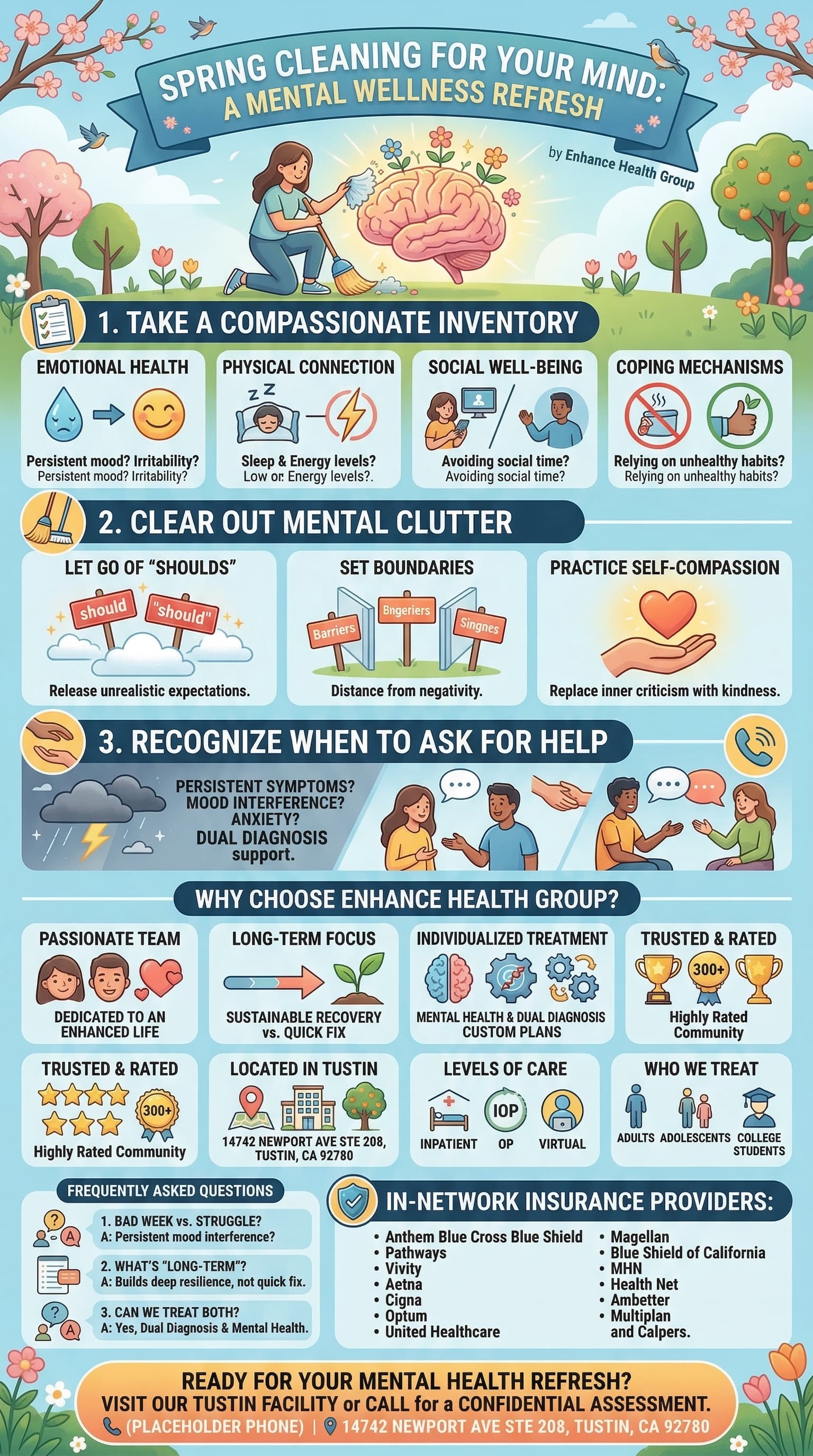
Anxious, low, or running on empty after having a baby is common, and Enhance Health Group in Tustin offers therapy, psychiatry, and a women's program called EVE for moms in Orange County. EVE covers pregnancy, the months after birth, and perimenopause and menopause. Most moms stay home with their baby or keep working while they get care, and one call to admissions will tell you where to begin.
If you're thinking about harming yourself or can't stay safe, call or text 988 right now.
Mental Health Resources for Moms in Orange County and Where to Start
The first resource worth reaching for is a licensed therapist who can sit down with you one to one and sort out what you're feeling. Many moms don't know whether they need therapy, medication, or just more sleep, and an assessment answers that. At Enhance, the assessment also decides which EVE track fits you: Eve Bloom during pregnancy, Eve Nurture after birth, or Eve Menopause for mood changes in perimenopause and menopause.
Care usually takes one of two forms. Outpatient therapy is the lighter option, and an intensive outpatient program (IOP) gives you more support during the week while you sleep in your own bed. Sessions use cognitive behavioral therapy (CBT) and dialectical behavior therapy (DBT) skills for anxious thoughts, low mood, and big emotions. If medication is part of your plan, a licensed psychiatrist prescribes and monitors it. Partners and family can join sessions when that would help, and video sessions are available for weeks when leaving the house with a newborn isn't realistic.
Smadar Rubinsky, LCSW, directs the maternal wellness program, so the people who built EVE are the ones shaping how it runs.
Outside our program, you have other places to look. Your OB or pediatrician can screen for postpartum depression and anxiety at a regular visit and send referrals. You can also call SAMHSA's National Helpline at 1-800-662-4357 for free referrals to treatment near you.
When you're ready to ask about our program, have a few things nearby: your insurance card, a rough sense of when symptoms started, and any medications you take now. You don't need a diagnosis or a polished explanation. Tell admissions what a normal day looks like right now, and they'll help you figure out the right level of care. You can read about our maternal wellness program before you call.
Signs It's More Than a Hard Season
A rough few weeks with a newborn looks different from postpartum depression or anxiety, and the clearest difference is how long it lasts and how much of your day it takes over. Tiredness lifts after a decent night's sleep. A low mood that stays after you've rested, or a worry that keeps running while the baby is fine, usually needs more than rest.
Some signs are easy to dismiss because they don't look like sadness. You might feel irritable or angry over small things, or you can't sleep even when the baby does. Others describe a tight chest, racing thoughts about everything that could go wrong, or a flat feeling where nothing is enjoyable, including your child. Pulling away from your partner and friends counts too, as does feeling like a bad mother, which is a symptom and not a fact about you.
These patterns aren't limited to the weeks after birth. Mood changes can show up during pregnancy, and they can return in perimenopause and menopause, when sleep, irritability, and anxiety often shift before anything else does. The three EVE tracks at Enhance, Eve Bloom, Eve Nurture, and Eve Menopause, exist because those stages look different in the therapy room.
Try looking at two weeks of your own days. If most of them include a symptom that gets in the way of eating, sleeping, working, or caring for your baby, that's worth a conversation with a clinician, and you don't have to wait for it to get worse.
If a partner or relative is the one noticing, say what you've seen in specific terms, such as "you haven't slept in three nights" or "you've stopped answering calls." That lands better than "you seem depressed, " and it gives her something concrete to bring to an assessment.
How the EVE Program Supports Pregnancy, Postpartum and Menopause
Each EVE track is built around a different stage, so care in pregnancy looks different from care after birth or in your late forties. A therapist places you in a track after your assessment, and you can be moved if your needs change.
Eve Bloom is for pregnancy. Sessions often center on anxiety about the birth, mood changes that surprised you, and the worry that you should be happier than you feel. Eve Nurture starts after the baby arrives and covers postpartum depression and anxiety, including the intrusive "what if" thoughts that keep new moms awake. Eve Menopause treats mood symptoms during perimenopause and menopause, such as new anxiety, low mood, and irritability that seem to come out of nowhere.
In every track, your individual therapist is the person you'll see most. You work on specific skills, like slowing a spiral of anxious thoughts or handling a strong emotion without letting it take over your afternoon. If your plan includes medication, you'll see a psychiatrist for that, and your therapist and psychiatrist work from the same plan.
Because EVE usually fits outpatient care or an IOP, you don't have to arrange for someone to take over your life. A mom with a six-week-old can ask about video sessions. A mom who works can ask admissions how IOP might fit around her job, since the care team sets the schedule after they meet you.
Partners can join family therapy sessions when it would help. Many couples find it easier once the partner hears, in the room with a clinician, what the mom has been carrying and what practical help would change things at home.
Outpatient and IOP Care That Fits Around a Baby and a Job
Outpatient therapy and IOP differ mainly in how much of your week they take. Outpatient usually means regular one-to-one sessions with your therapist, and it suits a mom whose symptoms are real but who is still getting through her days. IOP adds more contact during the week, which helps when anxiety or low mood is already getting in the way of work, sleep, or caring for your baby.
Your assessment decides which one you start with. Nothing is permanent, and the care team can step you up to more support or down to less as you change. Admissions will explain how your plan might work.
Scheduling is the part most moms worry about, and it's fair to ask about it directly. Our Tustin program offers PHP and IOP in person, and outpatient care is available by video through our virtual program. Video can mean a session during a nap or from your car after drop-off, with no commute and no childcare to line up. Bring your real constraints to the call, like daycare pickup times, a partner's shifts, feeding routines, or a pumping schedule, because the care team builds the schedule after they meet you.
If your symptoms are severe, or you can't stay safe at home, a higher level of care may fit better than outpatient or IOP. For mental health inpatient and residential care, Eden by Enhance (edenbyenhance.com) is our sister facility, and Enhance admissions is where you start so the right placement gets sorted out.
For a closer look at how the intensive option works, see our page on intensive outpatient treatment.
What Happens When You Call Admissions and Check Insurance
A person on the Tustin admissions team answers, asks a few plain questions, and starts checking your benefits while you're still on the line or soon after. Expect to be asked what's been going on, if you're pregnant or have a baby at home, how long the symptoms have lasted, and what medications you take now. You can answer in your own words, and it's fine to say you're not sure how to describe it.
For the insurance check, admissions contacts your insurance company, finds your deductible and copay, and tells you which level of care your plan may cover. Benefits vary by plan, so the answer is specific to yours. Enhance is in network with Anthem Blue Cross Blue Shield, Aetna, Cigna, Optum, United Healthcare, Blue Shield of California, MHN, Health Net, Ambetter, Multiplan, CalPERS, and Covered California. If your plan isn't on that list, ask anyway, because admissions can tell you what your options look like.
Once you have the numbers, you decide whether to continue. If you do, admissions walks you through the assessment that places you in an EVE track and sets your level of care. Nobody expects you to commit on the first call, and you can ask about video sessions or scheduling around your baby's routine before you decide.
Keep your insurance card in reach, and if it helps, jot down a few notes about your sleep, mood, and worries this week. Call (714) 862-1907, or use the Verify insurance button below to send your information and let the team check your benefits.
Common Questions
Can I bring my baby to an appointment?
Ask admissions before your first visit, because the answer depends on the type of session. Video sessions are the easiest option with a newborn, since you can take them from home while the baby naps or feeds. For in-person visits, tell the team about your childcare situation when you call so they can plan around it with you.
Will my husband or partner find out what I say in therapy?
Your sessions are confidential. Your therapist doesn't share what you say with your partner, your family, or your employer unless you give permission. If you'd like your partner to join a family therapy session, you decide that, and your therapist can help you plan what to cover so the conversation feels manageable.
Do I have to take medication?
No. Medication is part of the plan only when it makes sense for you, and a licensed psychiatrist makes that recommendation. Many moms start with therapy alone. If you're pregnant or nursing, tell the psychiatrist, because that shapes every conversation about medication, and you can ask questions and take time to decide before anything is prescribed.
What if I'm not sure I'm sick enough to need treatment?
You don't have to meet a certain level of distress to ask for an assessment. If symptoms are affecting your sleep, your work, or how you feel with your baby, that's reason enough to call. The assessment tells you what's going on and which level of care fits, and sometimes the answer is lighter support than you expected.
Can I get care if I live outside Tustin?
Yes. Enhance is based in Orange County and works with people from anywhere in California. Video outpatient sessions mean you can start care without driving to the office, and admissions can tell you whether an in-person program is realistic for your commute.