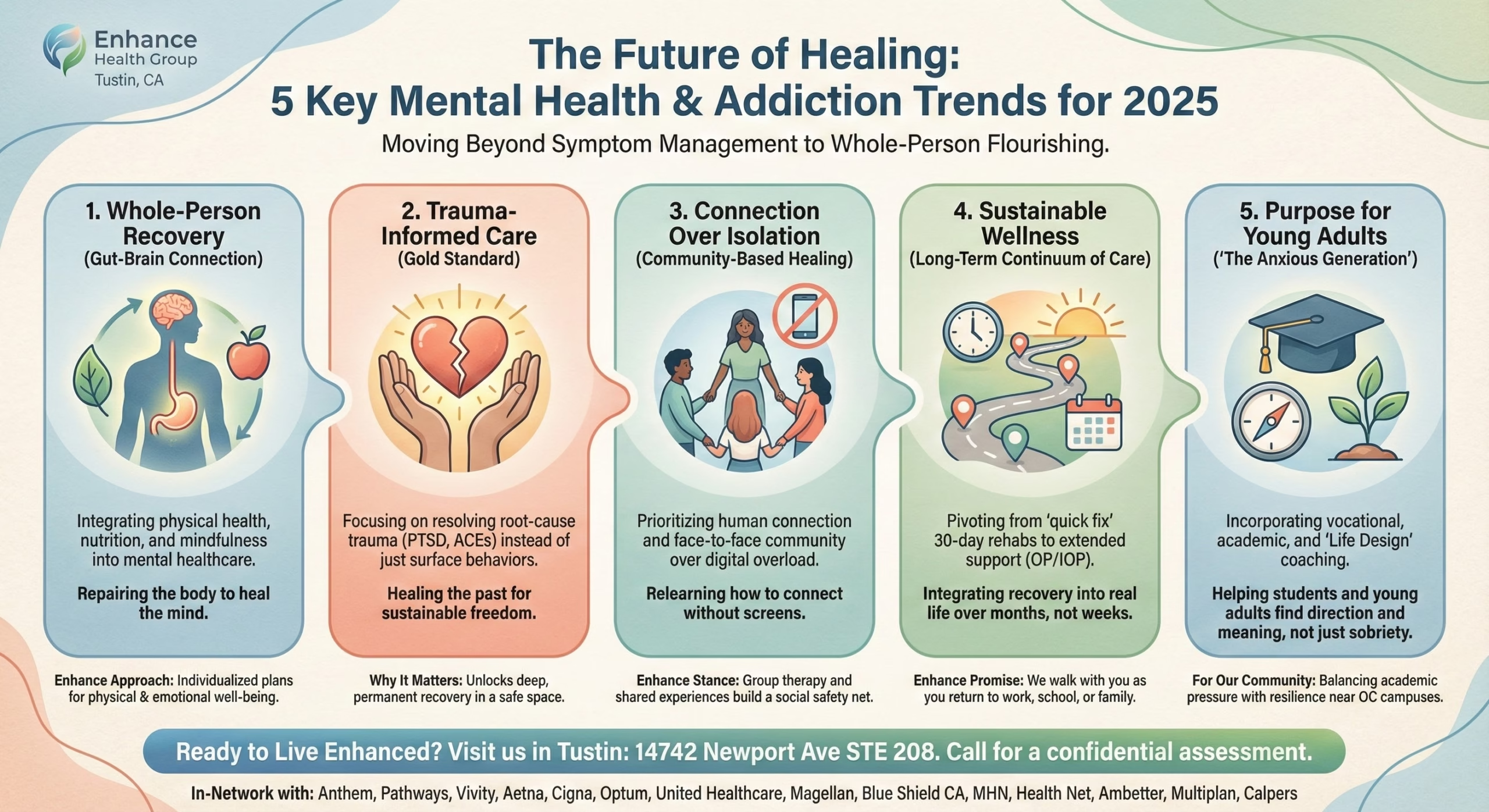
The biggest mental health trends 2025 brings to Orange County are practical ones: therapy you can do from home, one team treating depression and substance use together, and care that adjusts as you improve. Each of these changes what you can ask for when you call a provider. Here are five shifts that matter most when you're choosing treatment for yourself or someone you love.
Mental health trends 2025 that change what treatment looks like
Most of what's new in treatment this year isn't a new drug or a gadget. It's a change in how care is organized around you, so you spend less time fitting your life to a program and more time getting the right kind of help. That shows up in five places, and the rest of this piece takes them one at a time.
The first thing to know is that the label on a program matters less than what's inside it. When you call a provider, ask which level of care they're recommending and why. At Enhance Health Group, that could be a partial hospitalization program (PHP) or an intensive outpatient program (IOP) in Tustin, or outpatient therapy by video. The team can also tell you when someone needs a setting beyond those, and they'll point you toward it.
You'll also notice more providers asking about mental health and substance use in the same first conversation. Depression, anxiety, trauma and drinking or drug use often feed each other, so a good assessment looks at all of them before it sets a plan. Expect questions about your sleep, mood, medications, and what you're using and how often. Answer as plainly as you can, because the plan is only as accurate as what the clinician hears.
Accreditation and insurance are now fair questions to ask up front. Enhance is accredited by The Joint Commission, and the Tustin team will check your benefits and explain what your plan may cover, since coverage varies by plan.
Here's what to have ready for a first call:
- 1The name of your insurance plan and your member ID.
- 2A short list of current medications.
- 3The symptoms that worry you most, and how long they've been going on.
Virtual and hybrid care for therapy and recovery
Video sessions now cover far more than a quick check-in. Enhance offers outpatient therapy by video through virtualtreatmentcenter.com, and the site has virtual tracks for addiction, depression, anxiety and eating disorders. If your job, childcare or a long drive on the 5 or the 55 has kept you from starting, that format removes a real barrier.
Hybrid care means you don't have to pick one setting for good. Someone might start in person at our Tustin center for PHP or IOP, then shift some sessions to video as things steady. A new mother might do the reverse, using video in the first weeks after birth when leaving the house is hard. Ask admissions how a mix would work for your plan, because the care team decides it after an assessment.
A few practical things make video therapy work better:
- Pick a room where you can close the door, and wear headphones if others are home.
- Test your camera and connection before the first session.
- Keep your medication list nearby in case the clinician asks about it.
Video also has limits. If you're in active withdrawal, if you're not safe at home, or if your symptoms are severe enough that you can't get through the day, outpatient by screen usually isn't enough. Detox and residential addiction care happen at Embrace Treatment Center (embracetreatment.com), and Enhance admissions is still your first call so the team can match you to the right setting.
Your information stays private in virtual care, and sessions are confidential, so tell the clinician if someone else might overhear you.
Treating mental health and addiction together
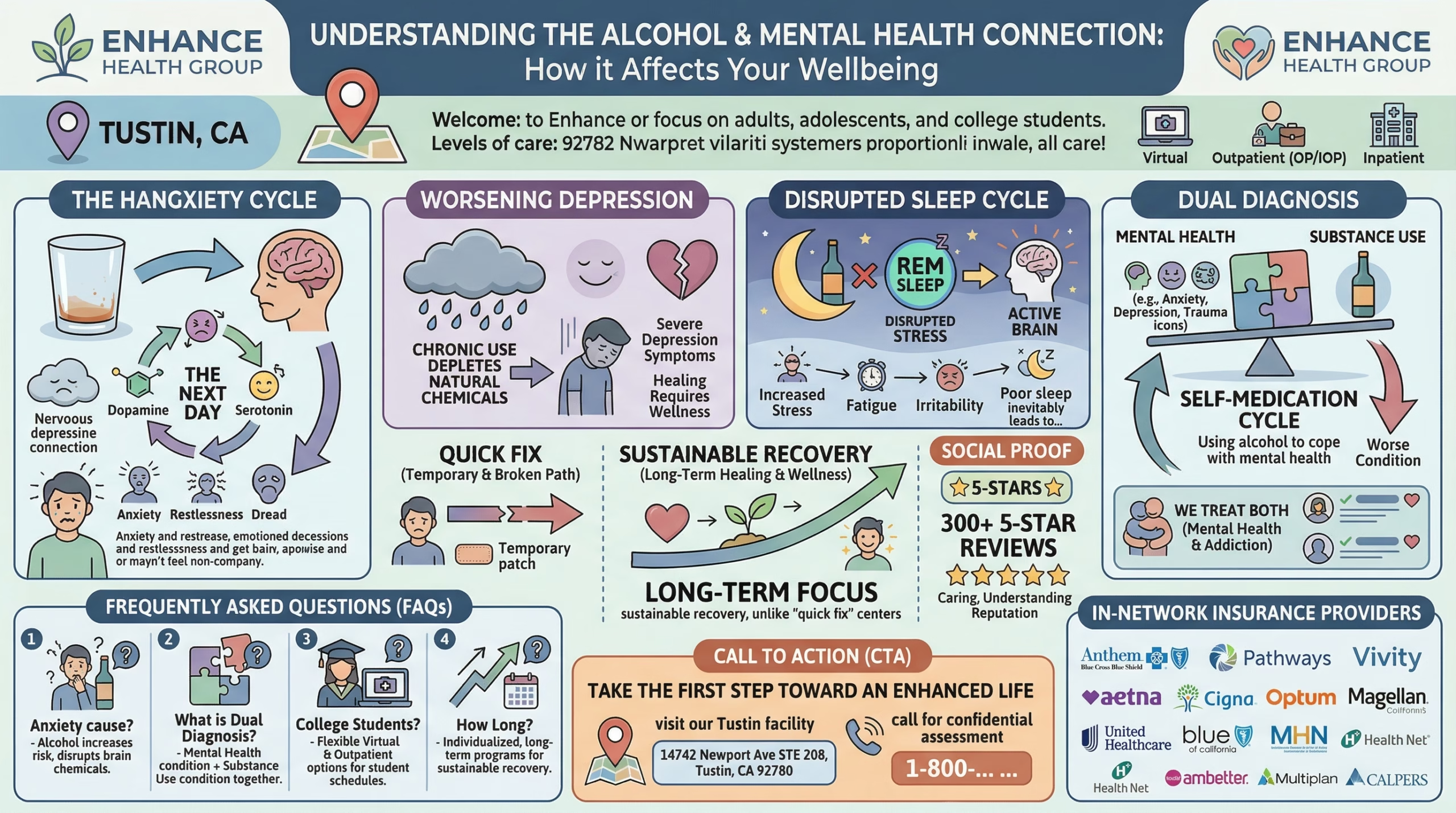
Roughly half the people who come in for drinking or drug use also have depression, anxiety or trauma symptoms underneath, and the reverse is true too. Dual diagnosis care is built for that overlap, with one team treating both conditions at the same time instead of sending you to one provider for your mood and another for your substance use.
The practical difference shows up in how the plan gets made. Rather than asking you to get sober first and deal with anxiety later, the clinicians look at how the two affect each other. Someone who drinks to get through panic attacks needs a plan for the panic as much as for the drinking. Someone whose depression deepens every time they stop using needs support for that stretch, not just a stop date.
Here's what that usually looks like in practice. At Enhance's Tustin center, you'll meet with a licensed therapist for individual sessions, and a psychiatrist can prescribe medication when it's part of your plan. Therapy often uses CBT and DBT skills, which give you concrete ways to handle anxious thoughts, cravings and strong emotions as they come up. The team adjusts the plan as they learn what's driving each symptom.
If you're helping a family member, you don't have to figure out which problem came first. That question matters less than getting an assessment that covers both. When you call admissions, describe what you've seen, such as changes in sleep, mood, drinking or drug use, and say plainly if you're not sure which is the main issue. The team will sort that out with the clinicians during the assessment.
Eden by Enhance (edenbyenhance.com) provides mental health inpatient and residential care when someone needs a setting beyond outpatient programs, and admissions can explain how that referral works.
Care that steps up or down as your needs change
Your first level of care is a starting point, and the team can change it as you do. Someone might begin in a partial hospitalization program (PHP) because symptoms are heavy, then move to an intensive outpatient program (IOP) once sleep and mood steady, and later to weekly outpatient therapy by video. The reverse happens too. If IOP isn't holding, the clinicians can recommend a more structured setting without treating it as a failure.
The team looks at a few things when they review your plan. They ask if you're safe at home, if substance use or withdrawal symptoms are part of the picture, how well you're functioning at work or with family, and how you feel about the current pace. Your own read counts. If you feel worse or you're slipping, tell your therapist early, because it's easier to adjust a plan in week two than after a crisis.
Stepping down works best when it's planned. Ask your clinician what has to improve before the next level makes sense, and who you'll see once the schedule changes. Families can ask the same questions, though what the team shares depends on what your loved one agrees to.
Supported living can add structure for people in PHP or IOP who need a steadier place to stay while they're in treatment. Admissions can tell you whether it fits your situation.
If you're ever in immediate danger, call 988 right away, and don't wait for your next session.
Women's mental health care around pregnancy, postpartum and menopause
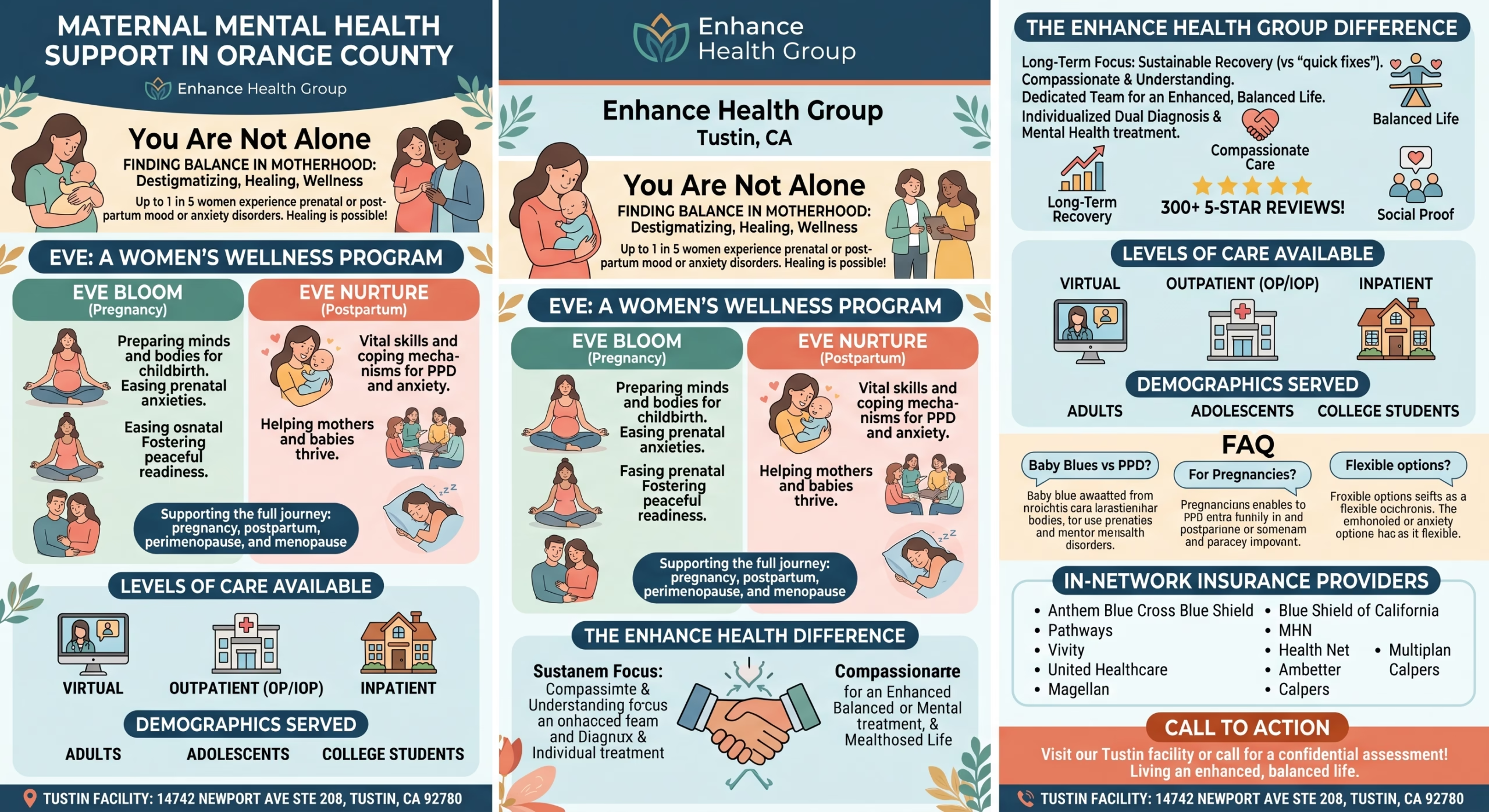
Mood symptoms often show up at three points in a woman's life: during pregnancy, in the months after birth, and through perimenopause and menopause. Enhance runs a program called EVE for exactly these stretches, and you can read about it on the maternal wellness page. It's directed by Smadar Rubinsky, LCSW, Director of Maternal Wellness.
EVE has three tracks. Eve Bloom supports you during pregnancy. Eve Nurture covers the time after birth, including postpartum depression and postpartum anxiety. Eve Menopause treats mood symptoms during perimenopause and menopause. You're placed in a track after an assessment, so you don't need to know which one fits before you call.
Treatment usually includes individual therapy with a licensed therapist, plus CBT and DBT skills for anxious thoughts, low mood and strong emotions. A licensed psychiatrist can prescribe medication when it's part of your plan. A partner or family member can join family therapy sessions when that would help, and video sessions are there for days when getting out of the house with a newborn isn't realistic.
EVE usually fits outpatient care or an intensive outpatient program, which means you can stay home with your baby or keep working while you're in treatment.
If you're a partner or relative, you might notice a few things worth mentioning to her or to admissions:
Sleep trouble that isn't explained by the baby's schedule.
Constant worry, or crying that doesn't ease up.
Pulling away from the baby, family or friends.
You don't need a diagnosis to call. Describe what you've seen, and the team will explain how an assessment works.
Checking insurance and making the first call
Benefits checks go faster when the person calling has the plan card in hand, and you don't need to have decided on a level of care first. When you call (714) 862-1907, admissions asks what's going on, who the care is for, and which insurance plan covers the person. Then the team contacts your insurance company directly.
Once they hear back, they explain your deductible, your copay, and which level of care your plan may cover. Benefits vary by plan, so what a neighbor or coworker was told may not match what you hear. Enhance works with Anthem Blue Cross Blue Shield, Aetna, Cigna, Optum, United Healthcare, Blue Shield of California, MHN, Health Net, Ambetter, Multiplan, CalPERS and Covered California. Pathways, Vivity and Magellan plans aren't in network, so tell the team early if you have one of those.
You can also send your details through the insurance verification form and let admissions call you back. Either way, hearing your coverage details doesn't commit you to anything. If you want to continue, admissions walks you through the next steps, and if you'd like to think it over or talk with family first, that's a fine place to stop.
If you're calling for someone else, say so at the start. Share what you've noticed, and be honest about what you don't know, because the clinicians will fill in the rest during the assessment.
Check your insurance or call admissions
Call (714) 862-1907. The Tustin team verifies benefits and explains what your plan may cover.