
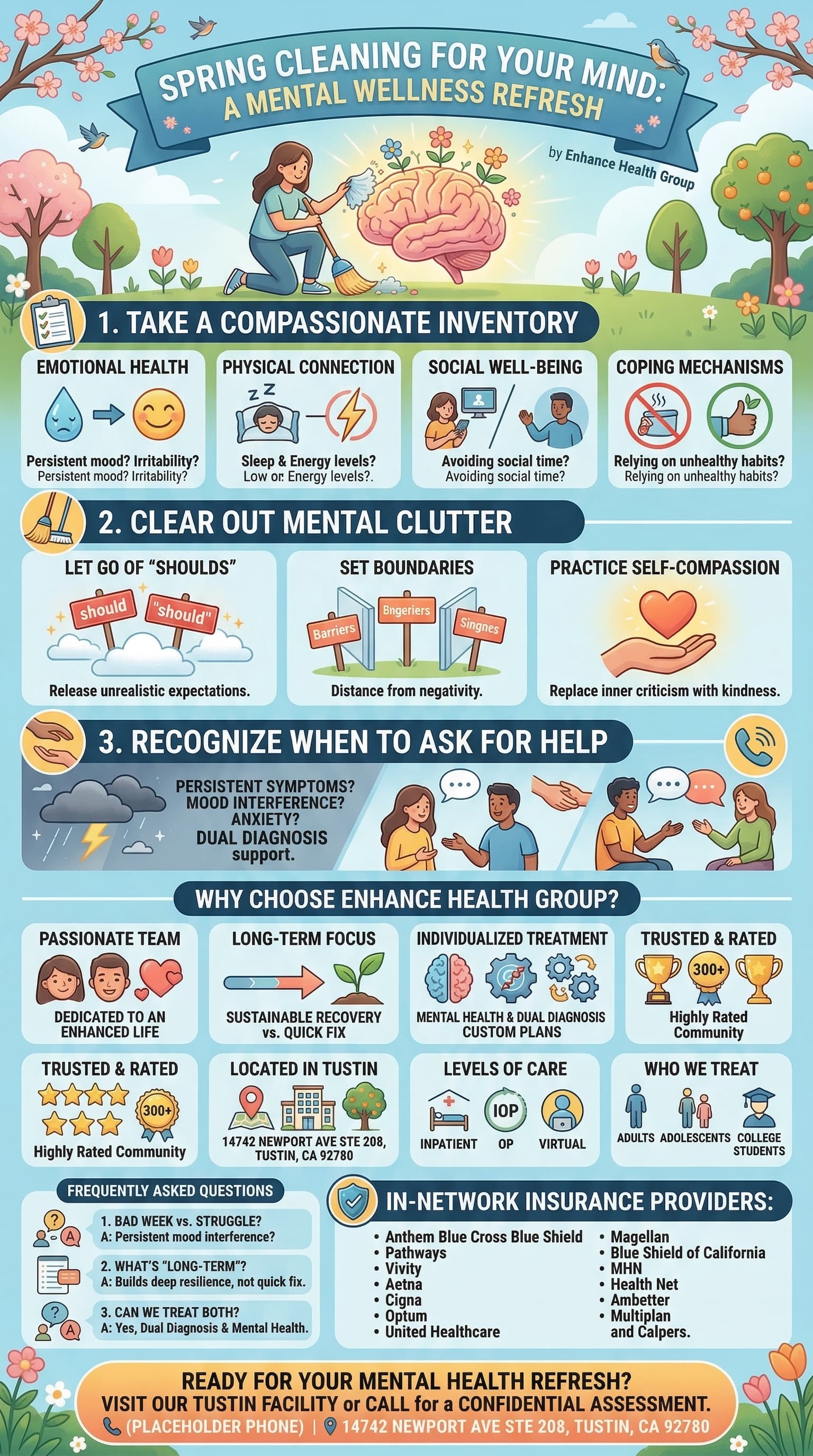
Ten minutes with a pen is enough to start a mental health self assessment. Write down how you've been sleeping, eating, working, and getting along with people over the last two weeks. Spring is a good time to do it, because you're already sorting through closets and calendars, and what you write gives you something concrete to bring to a clinician if the answers worry you.
If you're thinking about hurting yourself or ending your life, call or text 988 right now.
How to Do a Mental Health Self Assessment at Home
Start with a calendar, not a questionnaire. Look back over the last two weeks and mark the days you felt noticeably off, such as a bad night's sleep, a skipped meal, a canceled plan, or a day you could barely begin. Patterns show up on paper that you'd miss in your head.
Then go through five areas and give each one a plain note, not a score:
- 1Sleep. Write down how long it takes you to fall asleep, if you wake up at 3 a.m., and if you're sleeping far more than usual.
- 2Appetite and energy. Note any changes in how much you eat and any tiredness that hits by midday.
- 3Mood. Mark how often you felt sad, irritable, numb, or keyed up, and what was going on right before.
- 4Focus and work. Ask yourself if tasks that used to be routine now take twice the effort.
- 5People. Notice any pulling away from friends or family, and any worry they've voiced to you.
Be specific. "Slept badly" doesn't help much, but "awake by 4 a.m. five nights this week" does. Add anything you're using to cope, such as extra drinks in the evening or other substances, since a clinician will ask about it and it's easier to report when you've already written it down.
Keep the page. If most of your notes describe a bad stretch tied to something specific, like a deadline or a loss, give it a few more weeks and check again. If the same problems show up across several areas and haven't eased, that's the moment to talk with a licensed professional, and the notes you just made will save you time in that first conversation.
Signs Your Check-In Points to More Than a Rough Patch
A rough patch usually has a cause you can name and a shape that changes as the cause does. A bad month after a layoff, for example, tends to ease as you get steady again. What suggests something more is a pattern that doesn't follow your circumstances: the low mood, worry, or numbness stays put even when the stressful thing has passed, or it arrives with no trigger at all.
Look back at your notes for these signs:
- The same problems show up in three or more of the five areas, and they've lasted longer than two weeks.
- You've stopped doing things you used to enjoy, and not because you've been busy.
- Work, school, or parenting has slipped enough that other people have noticed.
- You're drinking or using more in the evenings to take the edge off, or to sleep.
- You have panic attacks, flashbacks, or intrusive thoughts that interrupt your day.
- Your notes keep describing the same dark stretch, and it's getting worse, not lighter.
Two details deserve extra attention. If substance use appears next to mood or anxiety symptoms, tell the clinician about both, because treating one without the other often leaves the problem in place. Dual diagnosis care, which Enhance offers, addresses that combination. And if loved ones keep saying they're worried, take that seriously. People often can't see their own changes from the inside.
You don't need to match a diagnosis before you call. Several of these signs together are reason enough to book an assessment, and a licensed clinician can sort out what's going on from there.
What a Professional Assessment Looks Like
A professional assessment is a conversation with a licensed clinician, not a test you pass or fail. At Enhance, the Tustin team starts by asking what's been happening, when it began, and how it's affecting your sleep, work, and relationships. Your notes from the home check-in fit right in here, so bring them along.
Expect questions about things you may not have written down. The clinician will ask about your history, including past treatment, medications you take, and whether anyone in your family has dealt with depression, anxiety, or addiction. They'll ask about alcohol and other substances in plain terms, and they aren't there to judge you. Honest answers help them see the whole picture, especially when mood symptoms and substance use are tangled together.
The point of the conversation is to decide what level of care fits. Some people do well with weekly therapy, and others need something more structured, like a partial hospitalization program (PHP) or an intensive outpatient program (IOP). The clinician explains why they're recommending a particular level, and you can ask questions about it before you decide anything.
A few things help you get more from the visit:
Bring your notes, plus a list of current medications and any previous diagnoses.
Say what worries you most, even if it feels minor or embarrassing.
Ask what the recommendation means for your work, family, and daily routine.
Your information stays private, and sessions are confidential. If you'd like a family member to join you for part of the conversation, you can say so. Many people find it easier to answer hard questions when someone who knows them is in the room.
Levels of Care When Weekly Support Isn't Enough
If an hour of therapy a week isn't holding your symptoms steady, the next step up is usually a program that meets you more often, and you can still sleep in your own bed. At Enhance, that means a partial hospitalization program (PHP) or an intensive outpatient program (IOP) at the Tustin center. PHP is the more structured of the two, and IOP is a step down that leaves more room for work, school, or family. Your clinician will tell you which one fits and explain why before you agree to anything.
Outpatient care also comes in a virtual form through virtualtreatmentcenter.com. It works well when the drive is the obstacle or your schedule is tight, and it's a good fit as a lighter level once you've stabilized.
Some situations call for a stay away from home. If you can't stay safe, or your home is where substance use keeps pulling you back, a residential or inpatient setting may be recommended. Mental health inpatient and residential care takes place at Eden by Enhance (edenbyenhance.com). Detox and addiction residential care takes place at Embrace Treatment Center (embracetreatment.com). Both are sister facilities owned and run by the same people as Enhance, and admissions at Enhance is where you begin, so you don't have to work out the right door on your own.
Levels of care aren't a one-way staircase. People move up when they need more support and step down as they get steadier. If you're also using alcohol or drugs, dual diagnosis treatment addresses the mood symptoms and the substance use together, which is why the clinician asks about both during your assessment.
Benefits vary by plan, so ask admissions what your insurance may cover for the level that's recommended.
How to Bring It Up With Someone You Love
Pick a private, unhurried moment, like a drive or a walk, rather than the middle of an argument or a family dinner. Starting with what you've seen works better than starting with a label. "You've seemed exhausted for a few weeks, and I've noticed you're not going to your Saturday games anymore" gives the person something real to respond to. "I think you're depressed" usually makes people defend themselves.
Say that you're asking because you care, then ask an open question and let the silence sit. Many people need a minute before they answer. If they brush you off, don't push for a confession. Tell them you'll ask again in a few days, and then do it.
Expect some of these reactions:
They say they're fine. That's common, and it doesn't mean you were wrong.
They get angry or embarrassed. Stay calm and don't argue about whether the problem is real.
They agree something's off but don't know what to do. This is your opening to offer a next step.
Offer to help with the small, concrete part. You can suggest they write down their own two-week check-in, or you can offer to sit with them while they call admissions at (714) 862-1907. The team asks what's been going on and walks through the options, so the person doesn't need the right words ready. If they'd like you in the conversation, you can say so up front.
You can't make an adult start treatment. What you can do is stay steady, keep the door open, and treat their no as "not yet."
What Happens When You Call Admissions
A member of the Tustin admissions team answers and starts by asking what's going on and what made you pick up the phone today. You don't need a diagnosis or a polished summary. If you've written down your two-week check-in, read from it.
Next, they'll ask for a few practical details: your name, the symptoms you've noticed, whether alcohol or other substances are part of the picture, and what kind of insurance you have. If you're calling for someone else, say so. They'll explain what the person would need to agree to before anything moves forward. Keep your insurance card nearby, because the member ID and the number on the back make the next step faster.
If you want to know what your plan may cover, admissions contacts your insurance company directly. They then explain your deductible, your copay, and which level of care your plan may cover. Coverage varies by plan, so you'll hear what applies to yours rather than a general answer. Enhance works with Anthem Blue Cross Blue Shield, Aetna, Cigna, Optum, United Healthcare, Blue Shield of California, MHN, Health Net, Ambetter, Multiplan, CalPERS, and Covered California, and the team can tell you whether your plan is among them.
Calling doesn't commit you to treatment. You can ask questions, think it over, and bring a family member into the next conversation. If you decide to continue, admissions schedules your assessment with a licensed clinician and walks you through what comes after.
Your information stays private throughout. Questions about your history are there to match you with the right level of care, not to judge you.
When you're ready, call admissions at (714) 862-1907, or use the Verify insurance button below to start with your benefits.
Check your insurance or call admissions
Call admissions. The Tustin team verifies benefits and explains what your plan may cover.


