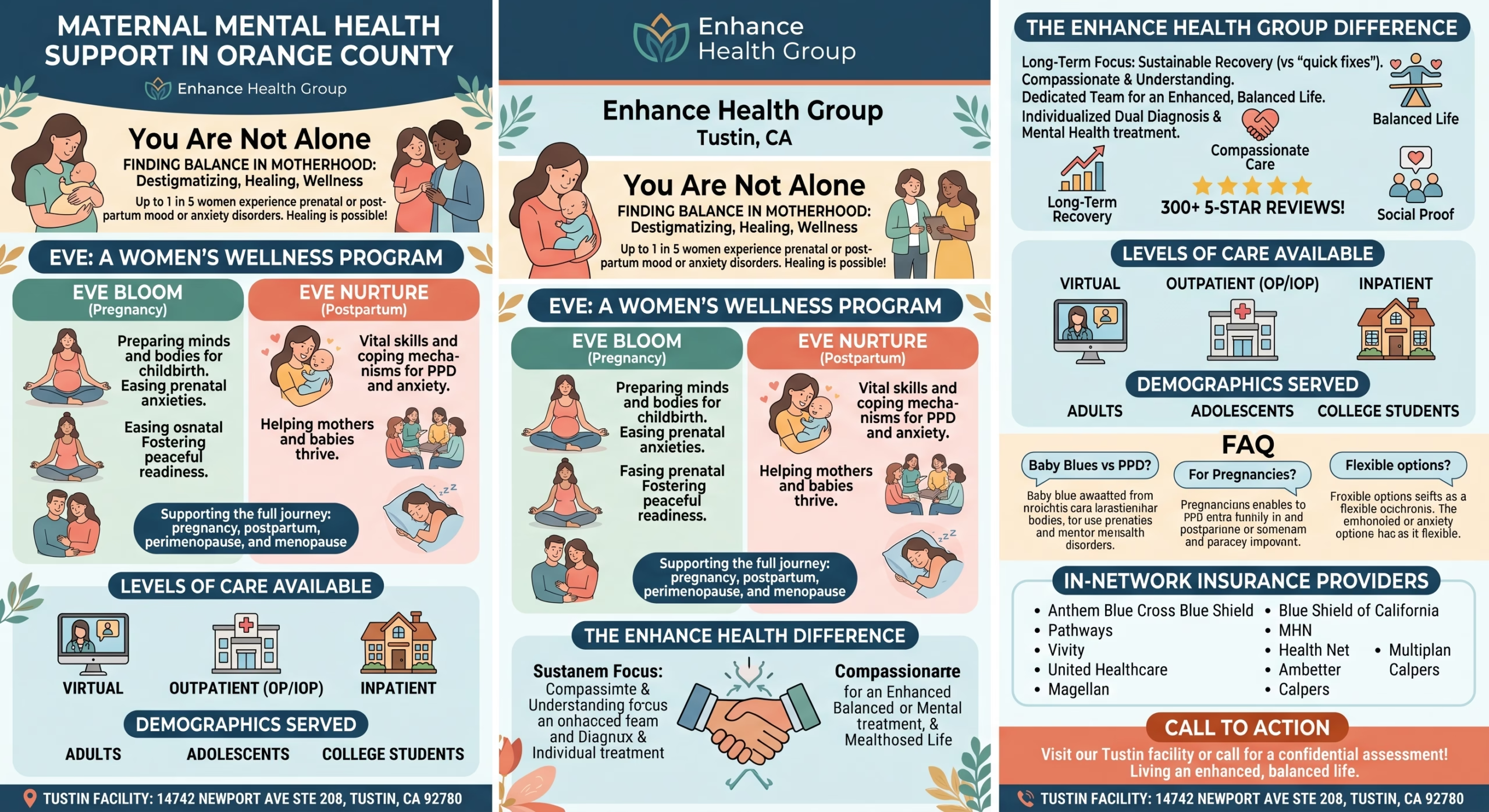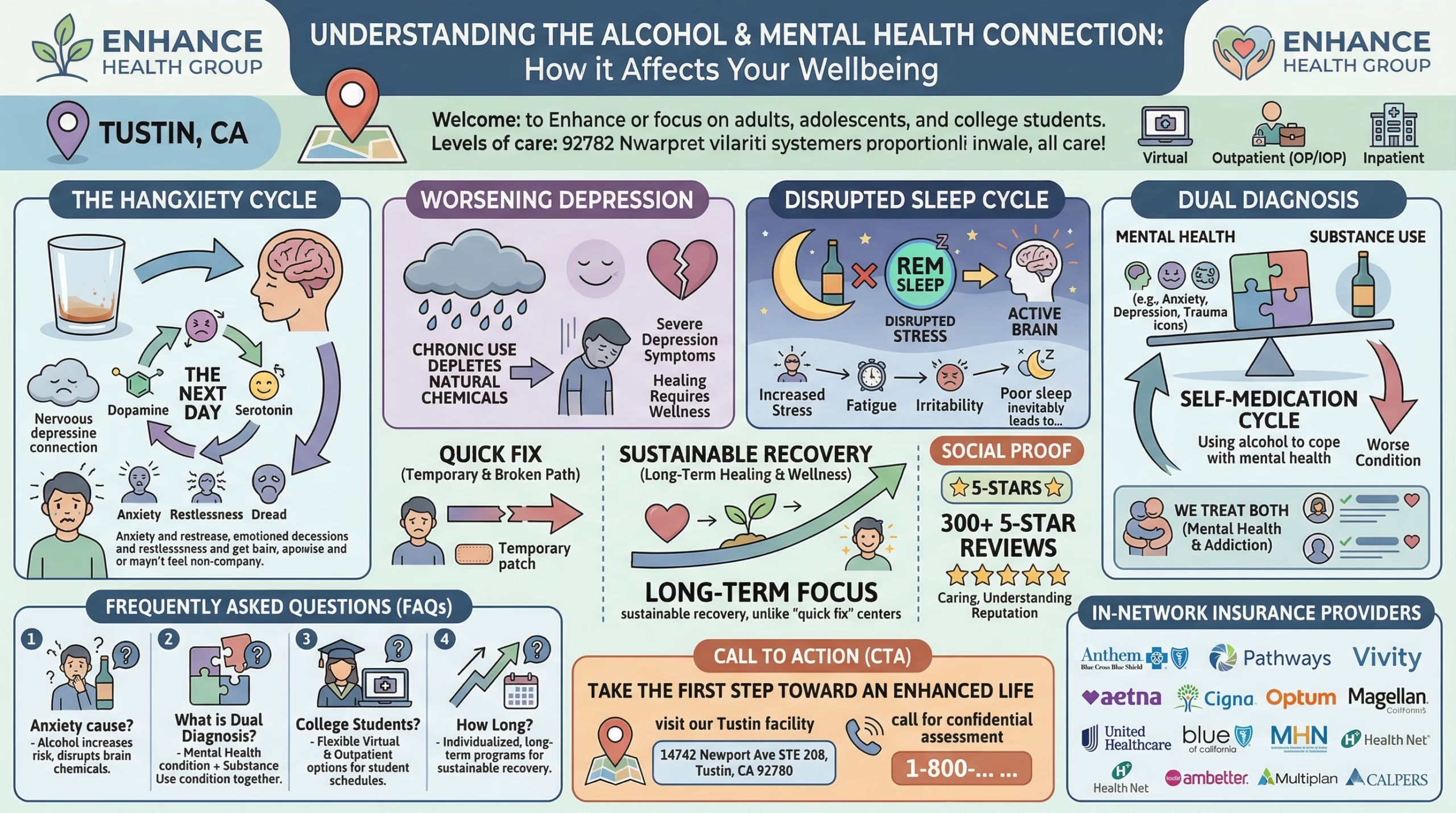

If your grades are slipping or you've stopped going to class, you don't have to wait for a semester break to get help. Enhance Health Group runs a partial hospitalization program (PHP) and an intensive outpatient program (IOP) in Tustin, plus virtual outpatient care you can do from your dorm or apartment, so college student mental health treatment in Orange County can be built around your classes. Admissions can walk you through which level of care matches what's happening.
College Student Mental Health Treatment Options in Orange County
Orange County students can choose from four levels of care at Enhance, and the right one depends on how much support daily life needs right now. Virtual outpatient care is the lightest option, with therapy sessions you join by video from wherever you study. An intensive outpatient program (IOP) adds more frequent treatment while you keep living at home or in your apartment. A partial hospitalization program (PHP) is the most structured of the three day options, and it's held at our Tustin center.
Dual diagnosis care is available too, for students whose anxiety or depression is tangled up with drinking or drug use. That's more common than most people expect, and treating both together usually works better than handling them separately.
Some students need more than a day program can give, such as a safe place to sleep or medical support through withdrawal. Detox and residential addiction care take place at our sister facility, Embrace Treatment Center, and Enhance admissions stays your first contact for that. Admissions can help you sort out which level fits before you commit to anything.
Because you'll likely be balancing treatment with classes, it helps to think about the level of care in terms of what's getting in the way:
- If you're functioning but anxious or low most days, virtual outpatient care may be enough.
- If you're missing assignments and sleeping badly, IOP may fit better.
- If you can't focus on school at all, PHP gives the most daily structure.
The care team makes the final recommendation after an assessment, so you don't need to diagnose yourself before you call. Our college students program page describes how treatment is set up for people your age.
Signs a Student Needs More Than Campus Counseling
Campus counseling centers usually offer short-term, weekly sessions, so the clearest sign you've outgrown them is that one hour a week isn't changing how your days go. If you're already seeing a campus counselor and still can't sleep, eat regularly, or get to class, a higher level of care deserves a conversation. At Enhance, that conversation starts with admissions in Tustin, and the next step up from weekly sessions is usually IOP or virtual outpatient care.
A few patterns point the same direction:
- You've missed a week or more of classes, or you're skipping exams and assignments because of how you feel.
- Panic attacks, crying spells, or racing thoughts happen most days, not just during finals.
- You're drinking or using drugs to get through the day or to fall asleep.
- Your symptoms keep coming back after short-term counseling ends.
- Friends or family have said they're worried, and you've stopped answering them.
Parents often see these signs first. Watch for a student who sounds flat on the phone, goes quiet for days, or mentions dropping a class without a clear reason. A change in sleep or eating is usually easier to spot than a change in mood.
Students who also have ADHD, trauma history, bipolar disorder, or an eating disorder may need a team that treats those conditions together, and our clinicians work with all of them. The care team can assess what's going on and recommend a level of care, which is why you don't have to sort out a diagnosis before reaching out.
If you're unsure whether your situation counts, ask yourself whether the way you're coping is costing you school, sleep, or relationships. If it is, it's reasonable to ask admissions about a program, even if you keep seeing your campus counselor in the meantime.
Fitting PHP, IOP or Virtual Outpatient Around Classes
Start with your class schedule, because the care team builds the plan from what you can realistically attend. Bring your syllabus dates, your exam weeks, and any lab or clinical hours that can't move. Admissions will ask about these during the call, and the answers shape which level of care makes sense for this term.
Virtual outpatient care is the easiest to fit around classes. You join sessions by video, so there's no commute from campus to Tustin, and you can take a session from a quiet spot in your apartment or a private study room. IOP and PHP ask for more of your week, since treatment happens in person at our Tustin center at 14742 Newport Ave, about 10 minutes from John Wayne Airport, which helps if you're flying in from another school. Session times are set by the care team after your assessment, so ask about them directly and compare them against your timetable before you decide.
Students sometimes assume treatment means dropping out. It doesn't have to, though a higher level of care can mean changing your course load. A few options to raise with your care team and your school:
Ask your academic advisor about a reduced course load or an incomplete in a single class.
Ask your school's disability or accessibility office whether treatment attendance qualifies for accommodations.
Request a medical leave only if the care team and your advisor agree your health needs a full break.
Plans can change. A student who starts in PHP may step down to IOP, and then to virtual outpatient care, as symptoms ease and classes pick back up. The care team reviews that with you as you go, so you aren't locked into one setup for the whole semester.
Raising Treatment With Your Student
Pick a calm moment that isn't tied to a grade, a fight, or a deadline, and start with what you've noticed rather than what you think is wrong. "You've seemed worn out since October, and I miss hearing from you" lands better than "Your grades are a problem." Students tend to shut down when a conversation sounds like a verdict, so describe specific changes in sleep, eating, or contact and then ask how things feel from their side.
Expect some pushback. Many students worry that treatment means leaving school, or that it will follow them on a record. You can answer both with facts: virtual outpatient care happens by video around classes, and sessions are confidential. Adult students also decide for themselves, so offer to sit next to them while they call admissions instead of making the call for them. Parents can ask about insurance and logistics, but your student should be the one describing how they're feeling.
If the first conversation goes badly, leave it for a few days and try again with a smaller request, such as an assessment with no commitment beyond that. Students who are 18 or older choose whether to share information with parents, so ask what they're comfortable with before you assume you'll be part of the process.
If you're the student reading this, you can start the conversation yourself. Tell a parent, a friend, or an advisor one concrete thing, like "I haven't been to class in two weeks and I can't tell why." That's enough to open the door.
What Accreditation and In-Network Status Tell You
Enhance Health Group is accredited by The Joint Commission, and you can check that yourself in the public locator, where we're listed as Enhance Health Group, LLC. Accreditation means an outside body has reviewed how the programs operate. It doesn't tell you whether a specific program will fit your schedule or your symptoms, so treat it as a baseline and not a recommendation. We also hold California Department of Health Care Services certification 300410AP, which you can cite if your school or your parents ask for it.
In-network status matters more to your wallet. We're in-network with Anthem Blue Cross Blue Shield, Aetna, Cigna, Optum, United Healthcare, Blue Shield of California, MHN, Health Net, Ambetter, Multiplan and CalPERS, and Covered California has its own page on our site. We're not in network with Pathways, Vivity or Magellan. If your card shows one of those names, ask admissions what your options are before you assume anything.
Many students are on a parent's plan, so the policyholder's name and date of birth are usually what admissions needs. Have the member ID and the phone number on the back of the card ready. Admissions contacts the insurer, then explains your deductible, your copay, and which level of care your plan may cover. Benefits vary by plan, and a benefits check isn't a guarantee of coverage or admission, so the answer you get is a clear picture of cost and not a promise.
Ask whether the policyholder will receive an explanation of benefits in the mail. If privacy from your family matters to you, that question is worth settling before treatment starts.
What Happens When You Call Admissions
The Tustin admissions team answers the call at (714) 862-1907, and the first few minutes are mostly questions about you, not paperwork. A staff member will ask what's been going on and how long it's been happening. They'll also want to know if you're already seeing a campus counselor or taking medication. You don't need a diagnosis or a polished explanation. "I can't focus and I've stopped going to class" is enough to begin.
Next, they'll ask about school. Share your term dates, exam weeks, and anything that can't move, since the answers help the care team decide between virtual outpatient care, IOP, and PHP. If you're calling for your student, expect the team to ask to speak with your student at some point, because adult students decide for themselves whether to enroll.
For the insurance check, have these ready:
Your insurance card, front and back, or a photo of it
The policyholder's full name and date of birth, if you're on a parent's plan
Your member ID and the number printed on the card
A list of any medications you take now
If you'd like to keep going, an assessment comes next, and the care team uses it to recommend a level of care. You can ask questions at every step, and nothing on the first call commits you to treatment.
You can also verify your insurance without calling. Use the form below, and the team will follow up with what they find.