
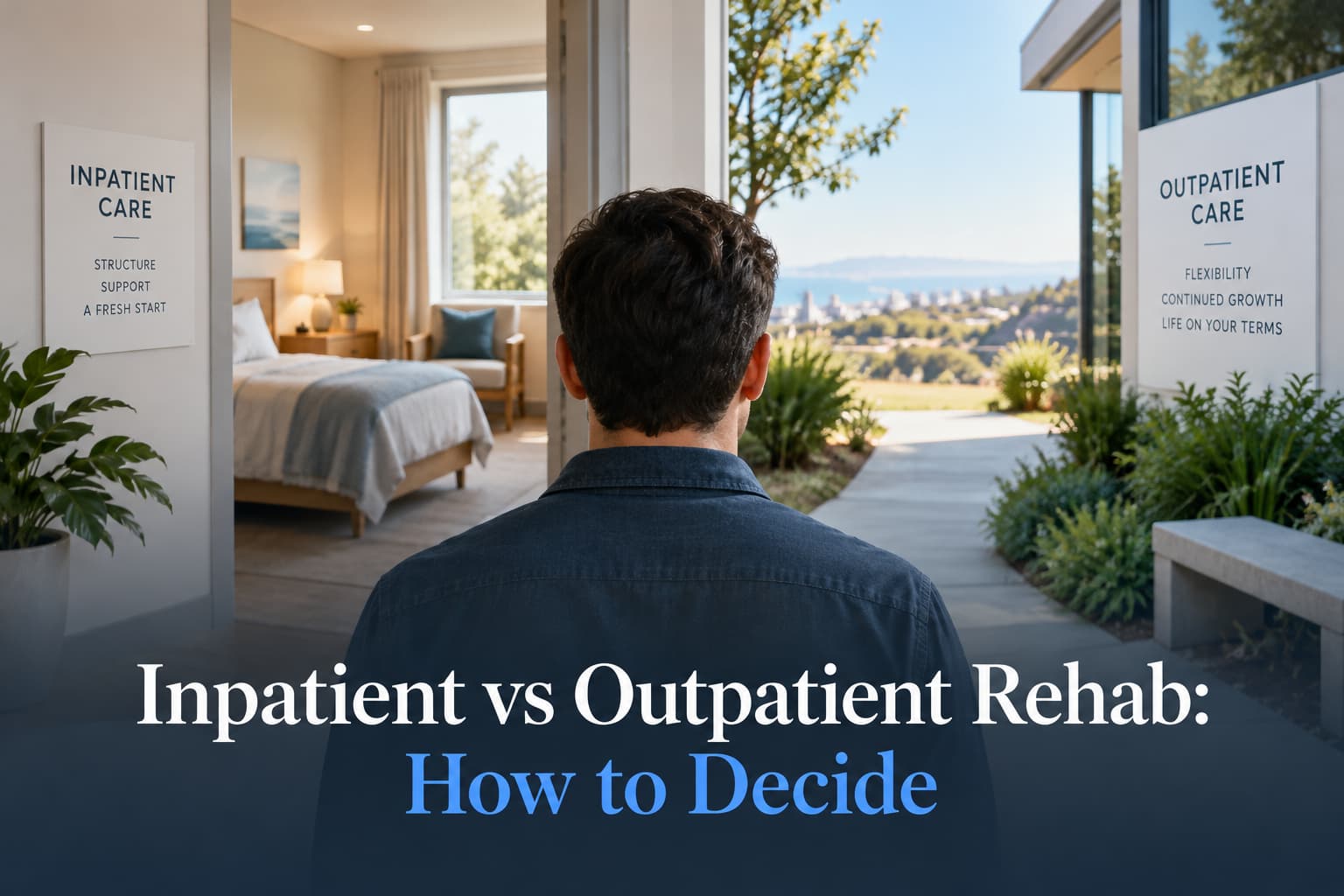
In the inpatient vs outpatient rehab decision, the deciding questions are whether you can stay sober at home, whether withdrawal needs medical care, and whether your home is steady enough to return to each night. If the answer to any of those is no, a residential setting is usually the safer place to start. If you have a stable home and can get to appointments, outpatient care often fits.
If you or someone you love is in crisis or thinking about suicide, call or text 988. If someone has overdosed or is in withdrawal with seizures, confusion, or trouble breathing, call 911.
Inpatient vs outpatient rehab: the signs that point to each
Start with what happened the last time you tried to stop. If you quit on your own and were using again within days, or you've tried more than once without a clinician involved, that pattern points toward residential care, where you sleep at the treatment site and aren't exposed to your usual triggers. The same goes if you drink or use every day, because stopping suddenly after heavy alcohol or benzodiazepine use can cause withdrawal that needs medical supervision. Detox comes first in those cases, and a clinician decides that after an assessment.
Your home matters as much as your history. Someone else using in the house, a partner who drinks, or no reliable place to sleep makes it hard to practice new skills between sessions. Outpatient care assumes you go home each evening and have something steady to go home to.
Signs that outpatient care may fit include having a stable home, a way to get to appointments, a job or family you need to stay near, and a recent history of staying sober for stretches at a time. Our Tustin programs run at two intensities. A partial hospitalization program (PHP) is the more structured step, and an intensive outpatient program (IOP) leaves more room for work and family. Virtual outpatient is another option if driving is the barrier.
A mental health condition changes the math too. If depression, trauma, or anxiety is driving the substance use, you'll want a program that treats both together, which is what dual diagnosis care does. You can read how we approach addiction treatment across these levels, and an admissions counselor can help you match what you've described to a starting point.
What inpatient rehab for addiction involves
Inpatient rehab means you live at the treatment site for the length of your stay, so the first thing that changes is your surroundings. You're away from the people, places, and routines tied to using, and clinicians are close by if cravings or withdrawal symptoms get hard to manage.
If you've been using alcohol or benzodiazepines daily, the stay usually begins with medical detox. A clinician assesses you first and decides what level of withdrawal care fits. Once you're stable, treatment moves into residential care, where you work with a therapist one to one, join group sessions, and start building a plan for what comes after you leave. Medication is part of the plan when a licensed prescriber decides it helps.
At Enhance, detox and addiction residential care take place at our sister facility, Embrace Treatment Center, which is owned and run by the same people. Our Tustin office doesn't house inpatient or detox care. Admissions at Enhance is still your first call, and the team will explain which setting your assessment points to and how the handoff works.
Before you go, it helps to have a few things ready:
- A list of what you use, how much, and when you last used
- Current medications and any medical conditions
- Your insurance card, so admissions can check your benefits
The care team sets the length of stay after they meet you, and they'll explain how they decided. Many people step down afterward into PHP or IOP, so the work continues while you live at home or in supported living.
If you're worried about work or kids, ask about that early. Admissions can talk through what leaving for a residential stay would look like for your situation, and whether outpatient could carry you instead.
What outpatient care looks like in Tustin
Outpatient care in Tustin means you sleep at home and come to the treatment center for scheduled sessions, so the first practical question is how you'll fit treatment around the rest of your week. Admissions can walk through that with you before you commit to anything, including what your work or school schedule can bear.
Most people start with an assessment. A clinician asks about your substance use, your health, your mental health, and your home situation, then recommends PHP or IOP. PHP is the more structured option and suits someone who needs close support but has a safe place to sleep. IOP is lighter, which makes it easier to keep a job or care for family while you're in treatment.
Once you're in a program, the work centers on therapy. You'll meet one to one with a therapist, join group sessions with other people in recovery, and practice skills for cravings and stress in your real life, then talk through how it went. If you also have depression, anxiety, or trauma, dual diagnosis care addresses it alongside the substance use rather than after it. If medication would help with cravings or mood, a licensed prescriber talks it through with you and you decide together.
Virtual outpatient is available if driving or childcare makes in-person visits hard. Sessions happen by video, and the care is built for the same goals.
Outpatient doesn't have to be permanent. If you're struggling to stay sober between sessions, tell your therapist early. The team can talk with you about adding support, including structured supported living, or whether a residential stay would serve you better. Many people also arrive in PHP or IOP after residential care, so outpatient can be your first step or the next one.
How to bring up the decision with someone who doesn't want to go
Pick a quiet moment when the person is sober and neither of you is angry. A conversation right after an argument, a missed shift, or a bad night usually turns into a defense of the past instead of a talk about what's next. Start with one specific thing you've seen, such as "You've missed three family dinners this month, and I'm scared." Avoid labels like "addict" or "alcoholic," which tend to end the conversation fast.
Ask before you tell. Questions like "What would make this easier for you?" or "What worries you most about getting help?" often bring out the real objection, and it's usually practical. Many people say they can't leave their job, can't be away from their kids, or don't want anyone to know. Those are solvable problems. If work is the worry, outpatient care may keep them on the job, and if the fear is the unknown, offering to make the first call together can take that weight off.
Offer a small next step rather than a full commitment. An assessment doesn't lock anyone into a program. It's a conversation where a clinician asks about use, health, and home life, then explains which level of care fits. Saying "Would you talk to someone for an hour, just to hear the options?" is easier to agree to than "You need rehab."
Expect more than one conversation. A first "no" is common, and pushing harder usually backfires. Leave the door open, keep your own boundaries clear, and try again in a few days. If you want help planning what to say, you can call admissions yourself first, and the team will talk through your situation even if your loved one isn't ready to join.
What happens when you call admissions and check insurance
A person on the Tustin admissions team answers, asks what's going on, and writes down what you tell them. Expect questions about what you're using and how often, when you last used, any medical or mental health conditions, and what you want from treatment. You don't need perfect answers. Rough ones are enough for a first call, and nobody will judge them.
Next comes the insurance check. Give them your plan name and member ID, or read the numbers off your card. Admissions contacts your insurer directly, then explains your deductible, your copay, and which level of care your plan may cover. Benefits vary by plan, so the answer for your neighbor may not be the answer for you. Enhance is in network with plans including Aetna, Cigna, Anthem Blue Cross Blue Shield, and Covered California, and the team will tell you plainly if yours isn't one of them.
If you'd like to start before you pick up the phone, the verify insurance form lets you submit your details and have admissions reach out to you.
After the benefits check, the team talks through what fits. That may be PHP or IOP in Tustin, or a conversation about detox or residential care at Embrace Treatment Center. If you want to continue, you go through admissions to schedule the assessment. You can ask any question along the way, including how a stay would affect your job or your kids, and you can stop at any point if you're not ready.
Calling for a family member is fine too. The team will talk through your situation and what you can do now, even if your loved one hasn't agreed to anything yet.
Call (714) 862-1907 to speak with admissions, or verify your insurance online.
Common Questions
Can I switch from outpatient to inpatient rehab if it isn't working?
Yes, you can move to a higher level of care at any point. If cravings are winning, you've returned to use, or home has become unsafe, tell your therapist right away. The clinical team will reassess and talk with you about whether a residential stay makes sense. Moving up doesn't mean you failed. It means the plan is being adjusted to what you need now.
Is a recurrence after outpatient treatment a reason to go inpatient?
A single slip doesn't automatically mean you need residential care. The team looks at how long you used, what triggered it, whether you could stop again on your own, and whether withdrawal is a concern. Sometimes the answer is more sessions or a step up from IOP to PHP. If use keeps returning despite that, residential care is worth discussing.
Does a stay at a residential center show up at my job?
Your treatment information is kept private, and you decide who hears about it. Employers generally aren't told why you're away unless you choose to share it. If you need time off, ask admissions early how people usually handle that conversation with work. Outpatient care can also let you keep your schedule, which some people prefer when privacy is a concern.
What if I have a mental health condition and an addiction?
You don't have to pick one to treat first. Dual diagnosis care treats depression, anxiety, trauma, or another condition alongside substance use, and it's available in our outpatient programs. If your symptoms are severe, the assessment will point to the setting that can keep you safe while both are addressed. Tell admissions about both on the first call so the recommendation reflects them.
Who decides whether I need inpatient or outpatient care?
A clinician makes the recommendation after an assessment, and you're part of that decision. They weigh your substance use history, withdrawal risk, health, mental health, and home situation. You can ask why they chose a level of care and what the alternatives would be. If you disagree, say so, and they'll talk through the options with you.


