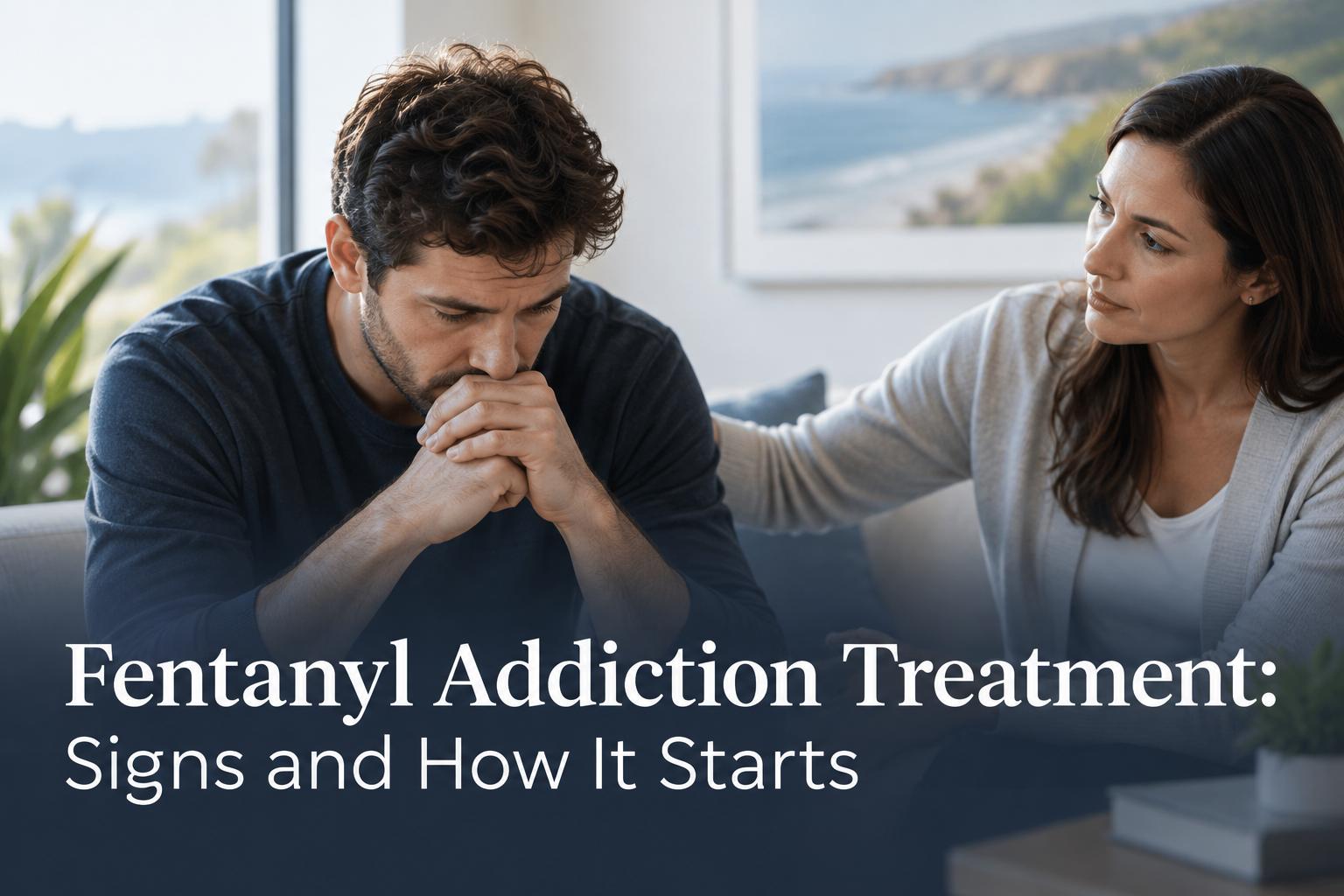
A phone call to admissions, a benefits check, and an assessment usually decide whether someone needs detox first or can begin in an outpatient program. If someone you love is using fentanyl, the sooner they're assessed, the sooner a clinician can match them with the right level of fentanyl addiction treatment.
If you or someone you love is thinking about suicide or self-harm, call or text 988 any time, day or night. You can also chat with a trained crisis counselor at [988lifeline.org](https://988lifeline.org). If someone is in immediate danger, call 911 right away for emergency help.
Signs that point to fentanyl addiction treatment
The clearest sign is that the person can't stop using even after fentanyl has already cost them something, like a job, a relationship, or a close call. Tolerance is the other early marker. If the same amount stops working and they're taking more, or taking it more often, the use has moved past what they control.
Withdrawal tells you a lot too. Someone who gets sweaty, nauseated, achy, anxious, or can't sleep when they go several hours without a dose is physically dependent. You'll often see them plan their day around getting and using the drug, and they may get irritable or panicky when supply runs short.
Changes in daily life are easier to spot than the drug itself:
- Pinpoint pupils, nodding off mid-conversation, or unusually slow speech
- Missed work, school, or family obligations that used to be routine
- Money going missing, or new secrecy about where they've been and who they're with
- Pills that look like prescription tablets but came from someone other than a pharmacy
- Pulling away from friends and dropping things they used to enjoy
Counterfeit pills are worth special attention. Tablets sold as oxycodone or Xanax can contain fentanyl in amounts nobody can see or measure, so a person who thinks they're taking something milder may already be dependent on it.
Fentanyl addiction also rarely travels alone. Depression, anxiety, and trauma often sit underneath the use, which is why Enhance assesses mental health and substance use together through dual diagnosis care. If you notice mood changes alongside the signs above, mention both when you talk with a clinician.
You don't need to see every sign before reaching out. One or two that keep happening, combined with your gut sense that something is wrong, is enough reason to ask for an assessment.
How to bring it up with someone you love
Pick a time when the person is sober, calm, and not about to leave for work or go use. Late at night or right after an argument rarely goes well, and a private spot matters more than the hour. Plan on a conversation that takes ten or fifteen minutes, not a confrontation that has to settle everything.
Start with something you've seen and how it's affected you. "I noticed you've missed the last few family dinners, and I'm worried" is easier to hear than "You have a problem." Avoid labels like addict, and don't ask them to explain or defend the use. Fentanyl dependence changes how the brain handles stress, so shame and pressure often push people to hide it harder.
Expect some pushback. Denial, anger, and "I can handle it" are common first answers, and they don't mean the conversation failed. Stay steady, say you'll keep caring either way, and leave one concrete offer on the table, such as sitting beside them while they call admissions or helping them look up their insurance card. If they say no, you can try again in a few days.
Before you talk, make the next step easy to say yes to. Call Enhance admissions yourself and ask what the first conversation involves. The team will ask about the substance use, any mental health symptoms, and what insurance the person has, then explain what happens next. Having that answer ready lets you say, "It's one call, and they check your benefits first, " instead of leaving the idea vague.
Adults decide for themselves whether to enter treatment, so you can't make the choice for them. You can still stay involved by offering rides, helping with paperwork, and joining family sessions when a clinician recommends them.
What happens when you call Enhance admissions
The person who picks up at (714) 862-1907 is on the Tustin admissions team, and the first few minutes are mostly questions. They'll ask what the person has been using, how often, and when they last used. They'll also ask about mood, sleep, and any past treatment, plus what insurance the person carries. Have the insurance card nearby, along with a list of any medications.
Next, admissions contacts the insurance company to check benefits. They then explain the deductible, the copay, and which level of care the plan may cover. Benefits vary by plan, so the answer for your loved one may look different from what a neighbor or coworker was told.
If the person wants to go forward, they continue through admissions. A clinical assessment follows, and it decides where treatment begins. Someone who is physically dependent on fentanyl and likely to go into withdrawal may be pointed to detox first. Someone who is stable enough may start in a partial hospitalization program (PHP) or an intensive outpatient program (IOP) in Tustin. Detox and addiction residential care take place at Embrace Treatment Center, a sister facility of Enhance, and Enhance admissions stays your first contact for arranging it.
You don't have to be the patient to call. A parent or spouse can ask how the process works, what the questions will be, and what to expect before the person agrees to anything. If the person isn't ready, you can still get answers and keep the information for the day they are.
For more on how Enhance approaches this substance, see the opioid addiction treatment page.
How detox fits in before treatment begins
Detox is the medically supervised stretch where fentanyl leaves the body, and for many people it comes first because withdrawal makes it hard to focus on anything else. Starting with it means the symptoms are managed by clinicians rather than endured alone, which is often what keeps someone from using again just to feel normal.
Whether detox comes first is the clinical team's call after the assessment. They look at how much and how often the person has been using, how recently, and what withdrawal symptoms are already showing. Someone who is dependent and close to withdrawal usually has a different starting point than someone who has already been off the drug for a while.
Detox is the start of treatment, not the whole of it. Clearing fentanyl from the body doesn't change the habits, stress, or untreated mental health symptoms that fed the use. Without a next step already lined up, the gap after detox is where many people slip back, so the plan for what follows should be settled before detox ends.
That's why Enhance admissions talks through the sequence up front. If detox is recommended, the team arranges it with Embrace Treatment Center, and then explains which program the person moves into afterward. You'd have one point of contact for both pieces instead of coordinating two separate intakes yourself.
A few practical things help the transition go smoothly:
- 1Keep the insurance card and medication list handy, since detox coverage is checked along with the rest of the benefits.
- 2Ask admissions what the step-down program will be before detox begins.
- 3Decide who can handle rides and paperwork, because those small tasks often stall a good plan.
Levels of care after detox in Orange County
Most people don't step straight out of detox into full independence. The clinical team usually recommends a program with daily structure first, and the options range across residential care, PHP, IOP, and virtual outpatient, so the plan can shift as the person stabilizes.
Residential care is the most structured. It's for people who need a stable place to live while they work on recovery, and it also happens at Embrace Treatment Center, so a person can often move out of detox into it without a new intake. Supported living is another option. It gives people in PHP or IOP a structured home with staff oversight, which matters if the home they'd return to has fentanyl in it or people still using.
Many people continue after detox into a partial hospitalization program (PHP) in Tustin, which gives them the most treatment time of the options where they sleep at home or in supported living. An intensive outpatient program (IOP) comes next. It keeps therapy and group work in the week while leaving room for work, school, or family. Outpatient care, offered virtually, is the lightest step and often the last one.
Therapy in these programs treats substance use and mental health together, because depression, anxiety, or trauma often drive relapse if they're left alone. That's the purpose of dual diagnosis care. Clinicians reassess along the way, so someone who struggles in IOP can move back up to PHP, and someone who's doing well can step down.
When you talk with admissions, it helps to ask:
Ask which program they recommend first, and what would move your loved one to the next one.
Ask where your loved one would live during that program.
Ask whether the plan covers the level of care they're recommending.
Checking insurance before you commit
Enhance is in-network with Anthem Blue Cross Blue Shield, Aetna, Cigna, Optum, United Healthcare, Blue Shield of California, MHN, Health Net, Ambetter, Multiplan, and CalPERS, and Covered California has its own page. Enhance is not in network with Pathways, Vivity, or Magellan, so if your plan is one of those, it's better to know before anyone starts planning around it.
Being in-network doesn't settle what your plan pays. Benefits vary by plan, and the verification call is where you find out how yours treats detox, PHP, IOP, and outpatient care separately. Each can carry a different deductible or copay, and a plan can cover one level and handle another differently.
Here's how the check usually goes:
You call, or send the form on the admissions page, with the member ID from the front of the insurance card.
Admissions contacts the insurance company directly, so you aren't left on hold with the payer yourself.
If you want to continue, you go forward through admissions, and nothing is decided before that.
A benefits check isn't a promise of coverage or admission. It gives you real numbers to weigh, and the clinical assessment still decides where treatment begins. If the figures look hard to manage, ask what the team recommends and what the other levels of care would cost under your plan.
Don't hold off on a decision about fentanyl treatment because the insurance question feels unanswered. It can be answered in one conversation, and the person you're worried about doesn't have to be on the line for it. Call admissions at (714) 862-1907, or use the Verify insurance button below, and the Tustin team will check your benefits and explain what your plan may cover.