
A Blue Shield of California plan may pay for treatment at our Tustin center, because Enhance Health Group is in network with that insurer. What your plan pays depends on your specific benefits, and admissions checks those before you commit to anything. A short call tells you which levels of care your plan may cover and what you'd owe.
If you or someone near you is thinking about suicide or self-harm, call or text 988 right now.
How Blue Shield of California covers rehab at Enhance
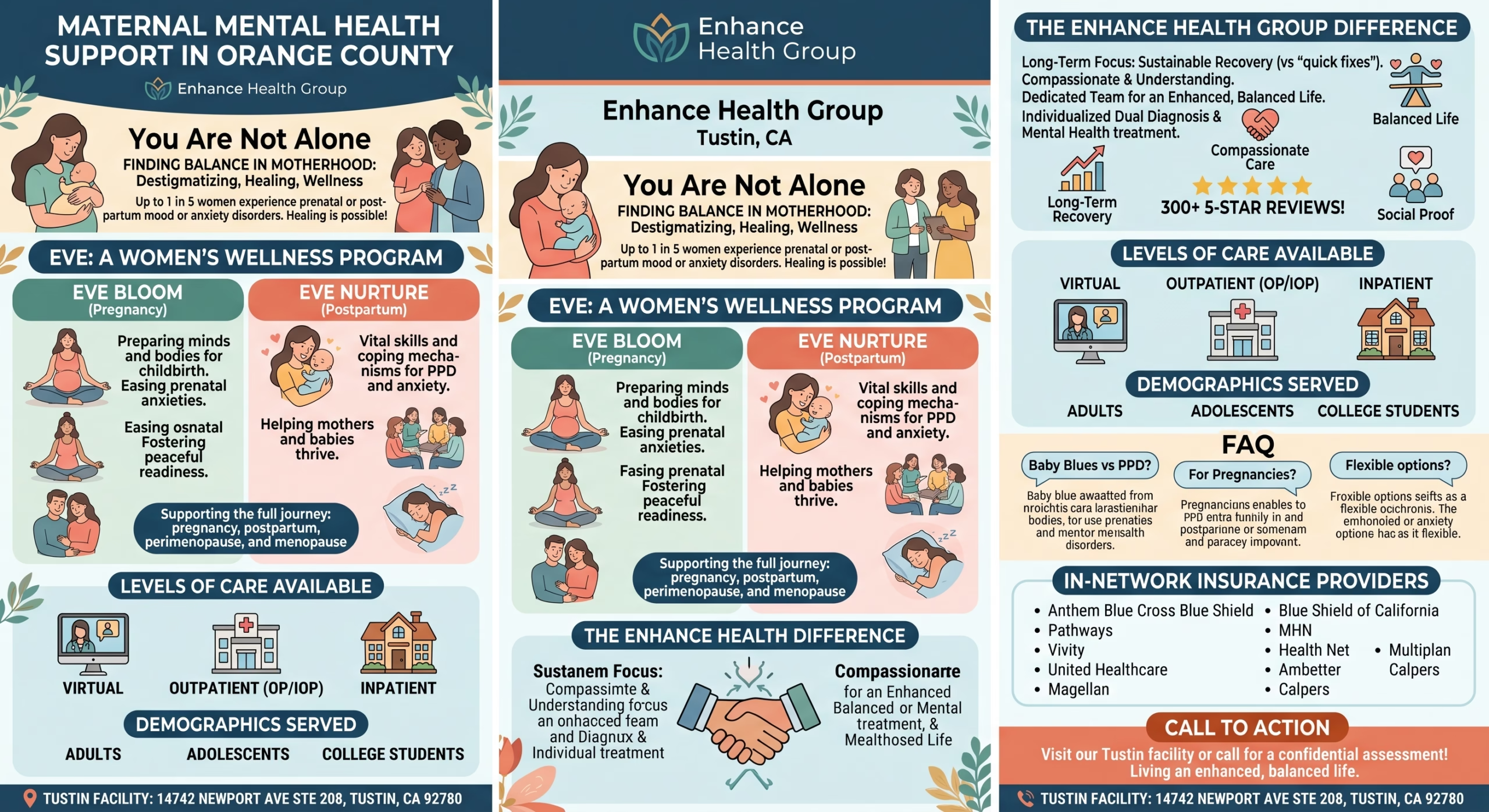
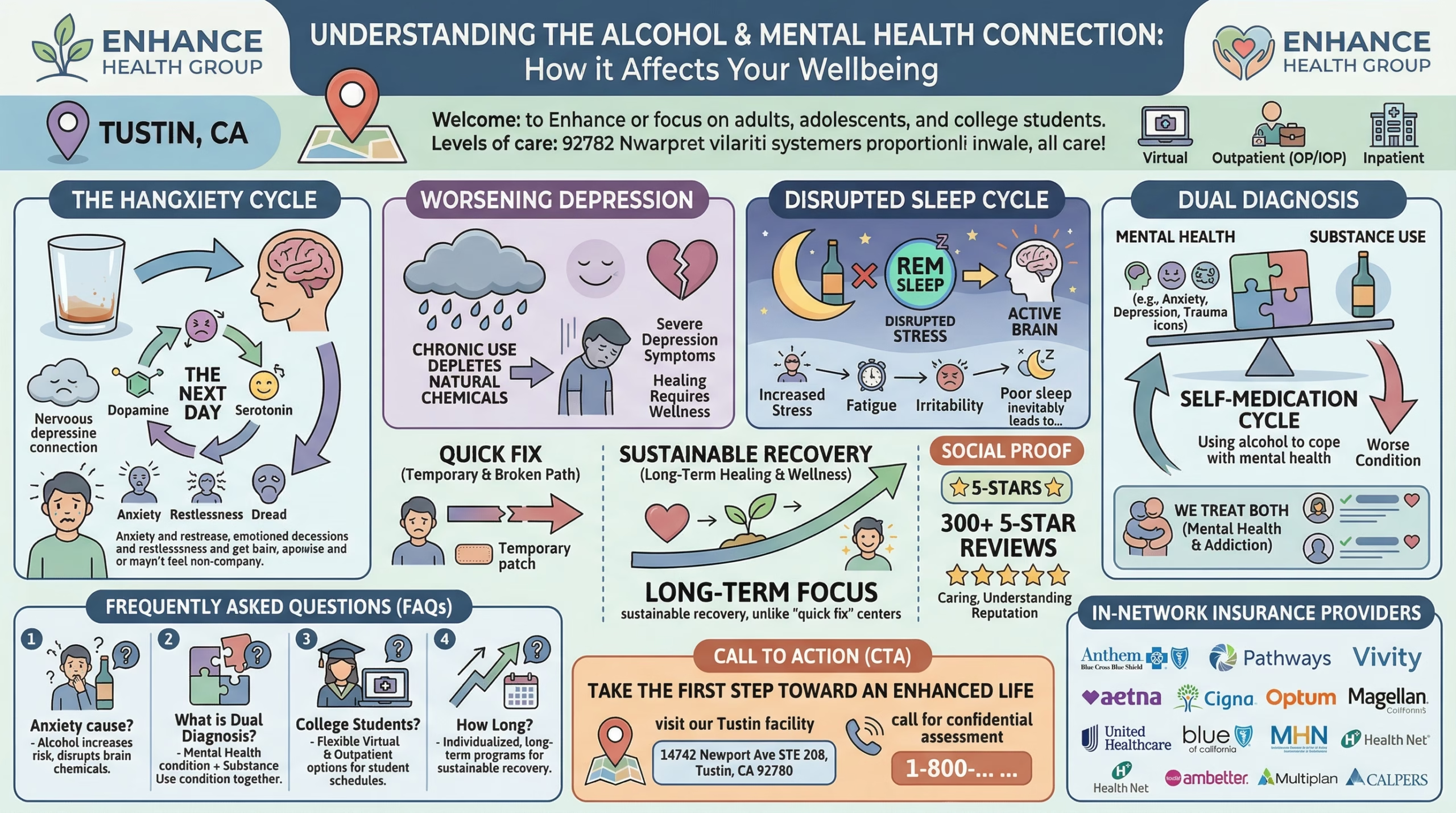
Blue Shield of California appears on the insurance page as an in-network plan, alongside Anthem Blue Cross Blue Shield, Aetna, Cigna, Optum, United Healthcare, MHN, Health Net, Ambetter, Multiplan and CalPERS. In-network means Enhance has a contract with the plan, which usually keeps your costs lower than going out of network. It doesn't tell you what your particular policy pays for each level of care, and that's the part that varies from one Blue Shield plan to the next.
Rehab isn't one service, so coverage isn't one answer. Enhance offers a partial hospitalization program (PHP) and an intensive outpatient program (IOP) at the Tustin center, plus virtual outpatient care. Detox and residential treatment for addiction happen at Embrace Treatment Center (embracetreatment.com), a sister facility owned and run by the same people as Enhance. Your plan may treat each of these differently, so the useful question is which level fits your situation and what Blue Shield says about that level.
Benefits vary by plan, and a benefits check isn't a guarantee of coverage or admission. What it does give you is real numbers before you decide. Admissions contacts Blue Shield for you, then explains your deductible, your copay, and which level of care your plan may cover.
You can see the full process on our Blue Shield insurance page, and the sections below walk through what that check involves, what drives your cost, and what to do if coverage comes in lower than you hoped.
What the benefits check with admissions involves
The check starts with a phone call or a form, and the person who picks up on the Tustin admissions team asks for your plan details so they can reach Blue Shield on your behalf. You don't have to call the insurer yourself or decode your policy booklet first.
Once admissions has Blue Shield on the line, they look at how your plan treats the level of care you're asking about. Then they explain it to you in plain terms. You'll hear three things:
- 1Your deductible, meaning what you pay before the plan starts paying.
- 2Your copay, meaning what you pay for each covered service.
- 3Which levels of care your plan may cover, such as PHP, IOP or virtual outpatient.
Those answers come from your plan, not from a standard Enhance price list. Two people with Blue Shield cards can hear different numbers because their employers or policies are set up differently.
If the numbers work for you and you want to continue, you move forward through admissions. If they don't, you've lost nothing but a short conversation, and you can ask what other options exist before you decide anything.
You can start the check by calling (714) 862-1907, or you can submit the verify insurance form and let the team contact you. Either route leads to the same benefits conversation, so pick whichever is easier on a hard day. Asking a few questions during that call costs you nothing, and it helps to write down what you hear, including the names of any terms you want explained again.
Which levels of care to ask your plan about
Ask Blue Shield about each level of care separately, because a plan can cover one differently from another. Start with the level your clinician or admissions counselor suggests, then ask about the ones on either side of it. That way you know your options if the first recommendation changes after an assessment.
At the Tustin center, the two to ask about are the partial hospitalization program (PHP) and the intensive outpatient program (IOP). PHP is the more structured of the two, and IOP fits people who are stable enough to live at home or in supported living while they attend treatment. Dual diagnosis care, which treats a mental health condition and a substance use disorder together, is a third question to raise if both are part of your situation.
Virtual outpatient care runs through virtualtreatmentcenter.com and is worth asking about if driving to Tustin is hard. Plans sometimes handle virtual sessions under different rules than in-person ones, so confirm that detail by name.
If you need inpatient mental health care, that takes place at Eden by Enhance (edenbyenhance.com), another sister facility run by the same people. Admissions remains your first call for that level too, and the team can check what Blue Shield says about it alongside the others.
When admissions reviews your plan, ask these in order:
- 1Which of these levels does my plan list as covered?
- 2Does any level need prior authorization before I start?
- 3Are my deductible and copay different from one level to the next?
Write the answers next to each level so you can compare them side by side later.
What decides your out-of-pocket cost
Four things on your Blue Shield policy set what you pay: your deductible, your copay or coinsurance, your out-of-pocket maximum, and whether the level of care needs prior authorization. Your plan documents list all four, and admissions can read them to you when they check benefits.
The deductible matters most early in the year. If you haven't met it, you may pay full contracted rates for services until you do. If you've already met it from other medical bills, you could owe much less. Ask admissions whether your deductible is individual or family, since a family plan sometimes tracks both.
Copay is a flat amount per visit or service. Coinsurance is a percentage of the cost after the deductible. Plans use one or the other for different services, so a PHP day and a virtual session might be priced differently. Ask which one applies to each level you're considering.
The out-of-pocket maximum is the ceiling. Once your spending on covered, in-network care reaches that number in a plan year, the plan generally pays the rest of covered services. Knowing how far you are from it helps you judge the real cost of a longer program.
Prior authorization is a different kind of cost. If your plan requires approval and it isn't obtained, a claim can be denied even for care that's normally covered. Ask admissions to confirm whether approval is needed and who requests it.
Costs vary by plan, so the numbers admissions reads back to you are the ones to plan around. Write down the deductible remaining, the copay or coinsurance for each level, and the out-of-pocket maximum so you can compare options with a clear head.
What to have ready before you call
Your insurance card is the one item admissions can't work without, and it's worth looking at both sides of it. The member ID and the group number on the front let the Tustin admissions team find your Blue Shield of California plan, and the customer service number on the back is useful if you want to confirm anything yourself later.
Beyond the card, a few details make the call faster:
The name on the policy, since it may be a spouse, parent or employer rather than you.
The policyholder's date of birth, which payers often use to match a record.
Your own date of birth, if you're the patient and not the policyholder.
A short description of what's going on, such as the substance involved, how long symptoms have lasted, or whether a mental health condition is part of it.
That last item helps the team point you toward the right level of care, so you don't need clinical vocabulary. Plain words are fine. If you've already seen a doctor or therapist, mention any diagnosis or medication, because it can change which options make sense.
Keep a pen and paper nearby, or open a notes app. You'll hear terms like deductible, coinsurance and prior authorization, and writing them next to each level of care makes the comparison easy afterward. If something sounds unclear, ask the person to say it another way. That's a normal request and they hear it often.
If you're calling for someone else, you can start the benefits check with the policy details alone. The person who'll be in treatment will need to take part in the conversation about starting care, but you don't need their permission slip in hand to learn what the plan may cover.
You don't need records, referrals or a finished decision before you call. The team can walk you through what comes next from wherever you are.
Options if your plan covers less than you expected
A lower-than-hoped benefits result usually means one of three things: a high deductible you haven't met, a level of care your plan limits, or a missing approval. Each has a different fix, so ask admissions which one you're looking at before you decide anything.
If the deductible is the issue, ask how much remains and whether a less intensive level, such as IOP instead of PHP, changes what you'd owe. A step down in intensity isn't always the right clinical call, but the care team can tell you whether it fits your situation, and the cost difference is worth hearing either way.
If your plan denies or limits a service, you can appeal. Blue Shield sends a written explanation of any denial, and the appeal instructions are in that letter. Ask admissions what clinical details would be useful to include, and keep the denial letter with your notes.
If a level of care is covered but approval is missing, ask admissions who requests it and how long Blue Shield usually takes to respond. Don't start treatment on the assumption that approval will come through.
You can also ask admissions about virtual outpatient care, which may be priced differently from in-person programs under your plan. Another option is to compare your Blue Shield benefits with any second plan in your household, since some families are covered under two policies.
None of these steps requires you to commit to treatment. You're gathering numbers so you can choose with full information, and the Tustin admissions team can walk through each option with you. Call (714) 862-1907, and they'll recheck your Blue Shield benefits and explain what your plan may cover for the level of care you're considering.