
Depression and alcohol treatment works best when one team treats both at the same time, because drinking deepens low mood and low mood pulls you back toward drinking. Treating only one usually leaves the other running the show. At Enhance Health Group in Tustin, a single plan covers therapy, medication management and substance use care together.
If you're thinking about harming yourself or feel you're in crisis, call or text 988 right now. If someone is in immediate danger, call 911.
Why depression and alcohol treatment works best as one plan
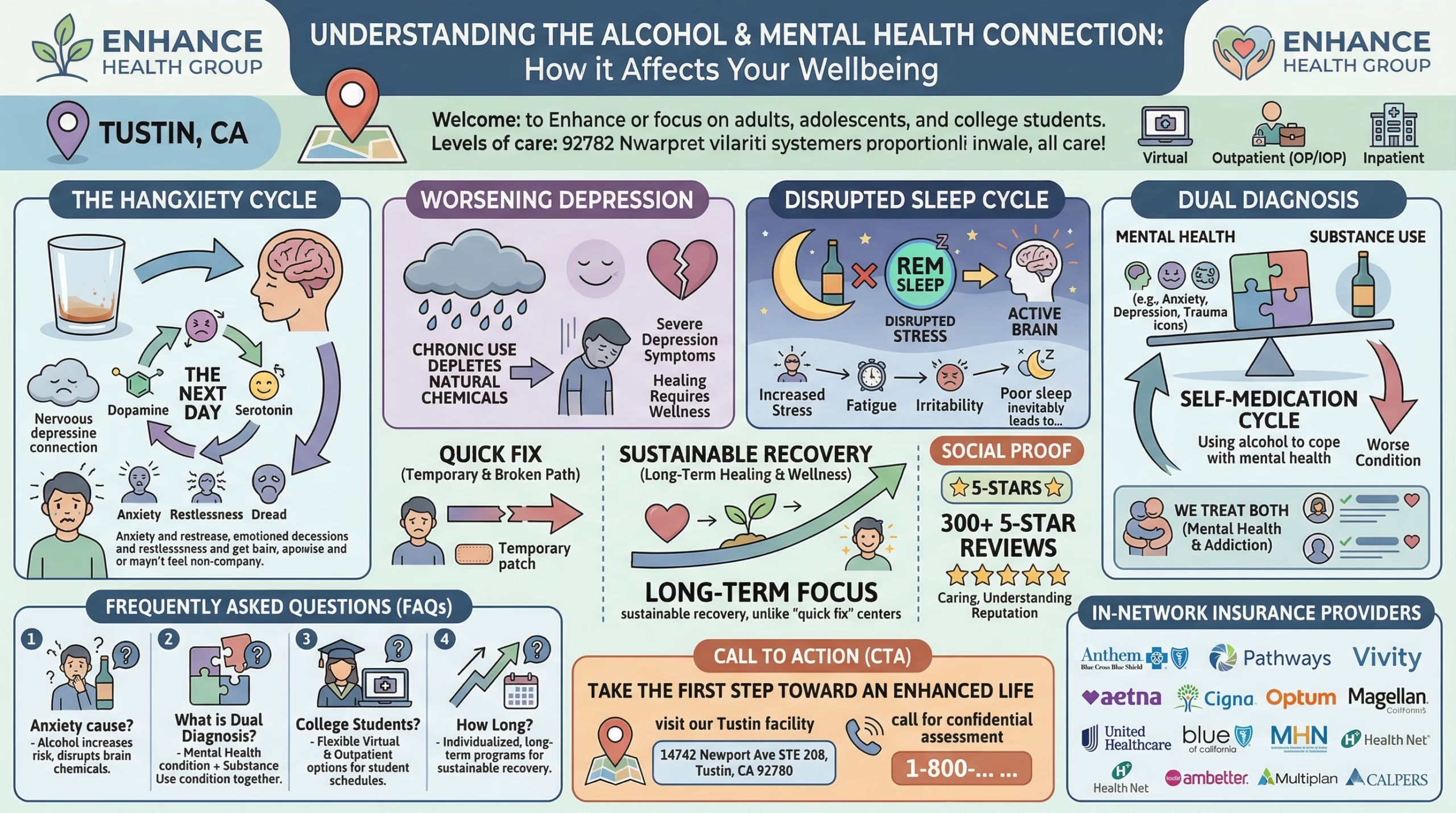
Alcohol is a depressant, so a few drinks to take the edge off tend to leave you lower the next day, and that dip is often what sends people back to the bottle. Depression does the same thing in reverse. When you feel flat, hopeless or exhausted, drinking can seem like the only thing that works for an hour or two. Each condition keeps the other going, which is why treating them in separate places, on separate schedules, so often stalls.
A one-plan approach means the same clinical team looks at both at once. In practice, that usually starts with an assessment that asks about your mood, your sleep, how much and how often you drink, and which came first, if you can tell. Those answers shape the plan. A therapist might work on the thoughts that feed hopelessness while also building ways to handle cravings and the evening hours when drinking tends to happen.
Medication can be part of this too. When a licensed psychiatrist prescribes for depression, they can do it knowing about your drinking, which affects what's safe and what's likely to work. That's much harder when one provider doesn't know what the other is doing.
The level of care depends on what the assessment finds. Someone who is drinking heavily may need medically supervised detox first, and that happens at Embrace Treatment Center (embracetreatment.com), a sister facility of Enhance. Others do well in a partial hospitalization or intensive outpatient program. Our dual diagnosis treatment in Orange County page explains how those fit together.
Signs that drinking and depression are feeding each other
Pay attention to the timing. If your mood is lowest the morning after you've been drinking, and the first drink of the evening is what lifts it, the two are already linked. Many people notice this pattern before they can say which problem started first, and the order matters less than the loop.
These signs tend to show up together:
- You drink to fall asleep, then wake at 3 a.m. anxious or hopeless.
- You've cut back or stopped for a few days, and your mood dropped sharply instead of improving.
- Things you used to enjoy have slipped, and drinking is what fills the empty hours.
- You've told yourself you'll deal with the drinking once you feel better, or deal with the low mood once you stop drinking.
- Someone close to you has pointed out a change in your mood or your drinking, and you've brushed it off.
That fourth sign is worth a closer look. Waiting to feel better before you stop drinking, or waiting to stop drinking before you treat the depression, is the exact split that keeps both conditions going. Neither one clears up on its own while the other stays untouched.
Families often see the pattern first. A parent might notice that their adult son withdraws on weekdays, drinks heavily on weekends and seems worse each Monday. A spouse might see that the drinking rises whenever work or relationships get harder. Those observations are useful to bring to an assessment, because clinicians ask about timing, sleep, appetite and how drinking has changed over the past few months.
You don't need to sort out the diagnosis yourself. If two or more of these signs sound familiar, that's reason enough to ask for an assessment that looks at both conditions together.
What each level of care looks like for both conditions
The starting point is an assessment, and what it finds decides where you begin. Someone who has been drinking daily and could have withdrawal symptoms usually begins with detox, which happens at Embrace Treatment Center, and then steps down to a program that treats the depression and the drinking together. We've already covered that first step, so here's what comes after it.
Partial hospitalization (PHP) is the most structured option you can do while living outside a treatment facility. It's run from our Tustin center and fits people whose depression is severe or whose drinking keeps interrupting daily life. Expect individual therapy, group work and medication management in the same program, so your psychiatrist and your therapist are working from one shared plan.
Intensive outpatient (IOP), also in Tustin, suits people who are steadier and need to keep working or caring for family. The therapy is the same kind of work, with more room in your week for everything else.
Virtual outpatient is the lightest level. It works well as a step down after PHP or IOP, or when getting to an office is the barrier.
If depression is severe enough that safety is the main concern, inpatient mental health care is provided at Eden by Enhance (edenbyenhance.com), a sister facility. Your assessment will say whether that's the right fit.
Levels aren't a one-way ladder. People often move between them as symptoms change, and the team adjusts the plan with you when that happens.
How to bring it up with someone who drinks and feels low
Pick a quiet, sober moment, not the morning after a bad night or while they're drinking. A calm conversation over coffee on a weekend goes better than a confrontation at 9 p.m. with a glass in their hand.
Start with what you've seen and how it makes you feel, rather than a label. "I've noticed you've seemed really down lately, and the drinking has picked up. I'm worried about you" gives them something to respond to. "You're an alcoholic" or "you're depressed" usually ends the conversation. Keep to specifics, like the sleep, the skipped plans, or the change since spring, because specifics are harder to argue with than a verdict.
Expect pushback. Many people answer with "I'm fine" or "I just drink to relax." You don't need to win that point. Say you're not asking them to quit forever today, you're asking them to talk to someone who can look at the mood and the drinking together. Offer to make the call with them or sit beside them while they do.
If it goes badly, you haven't ruined anything. People often need to hear it more than once before they act, so you can bring it up again a week or two later, in the same calm way.
When they're ready, or if you want to ask questions first, the Tustin admissions team can talk with you or your loved one. They'll ask about mood, drinking and any current medications, then check insurance benefits. Having a few notes about what you've observed helps, and you can call on your own behalf if the person isn't ready yet.
What happens when you call admissions and verify insurance
A person at the Tustin admissions team answers and starts with a few plain questions about the person who needs care: what's been going on with mood, how much and how often they drink, and any medications they take now. You don't need records or a diagnosis in hand. Notes on what you've noticed, the name of the insurance plan, and the member ID from the card are enough.
If you're calling for someone else, say so. You can ask questions and start the insurance check before your loved one is ready to talk, though they'll need to take part in the assessment itself.
Here's how the insurance check usually goes:
- 1You call or send the form on the insurance page.
- 2Admissions contacts your insurance company directly.
- 3They explain your deductible, your copay, and which level of care your plan may cover.
- 4If you want to continue, you go through admissions to set up the next step.
Enhance is in-network with Anthem Blue Cross Blue Shield, Aetna, Cigna, Optum, United Healthcare, Blue Shield of California, MHN, Health Net, Ambetter, Multiplan and CalPERS, and Covered California has its own page. Benefits vary by plan, and a verification tells you what your plan says, not whether it will cover a specific stay. If your plan is Pathways, Vivity or Magellan, ask about it on the call, since Enhance isn't in network with those.
Ask admissions anything that's been holding you back. Many people want to know whether treating depression and drinking together costs more, what the first week looks like, or how to keep working. The team can walk through those with you, and nothing you share on the call commits you to anything.
When you're ready, call (714) 862-1907 or use the Verify insurance button to have the Tustin team check your benefits.
Common Questions
Which should be treated first, depression or alcohol use?
Neither one waits for the other. Both are treated together from the first assessment, because stopping drinking alone can leave low mood untouched and treating mood alone leaves the cravings in place. The assessment shows which needs more attention right now, and the plan weights therapy, medication and substance use care to match that.
Can antidepressants be taken if I'm still drinking?
Tell your psychiatrist exactly how much you drink before any prescription is written. Alcohol can change how some medications work and how safe they are, so the prescriber needs the real picture to choose well. Please don't stop or start a medication on your own, especially if you've been drinking daily, since sudden changes can cause problems.
Does depression go away once I stop drinking?
Sometimes mood lifts noticeably after drinking stops, and sometimes it doesn't. Clinicians can't tell which applies to you until the alcohol is out of the picture and they've seen how your mood behaves. That's one reason depression is treated at the same time, so a lingering low mood gets care instead of being mistaken for willpower.
Will I have to put work and family on hold?
Not necessarily. Intensive outpatient and virtual outpatient care are built to fit around a job or caring for family, while partial hospitalization asks for more of your week. Your assessment decides which level fits your symptoms, and the plan can shift as you steady. Bring up your work and family situation on the call so it shapes the recommendation.
Is it a problem if I've tried to quit before and relapsed?
No, and it's useful information for the team. Many people have tried to quit more than once, and a past attempt often shows what got in the way, such as untreated depression, poor sleep or stress at certain times of day. Share it openly during the assessment so the plan can address those gaps instead of repeating what didn't hold.