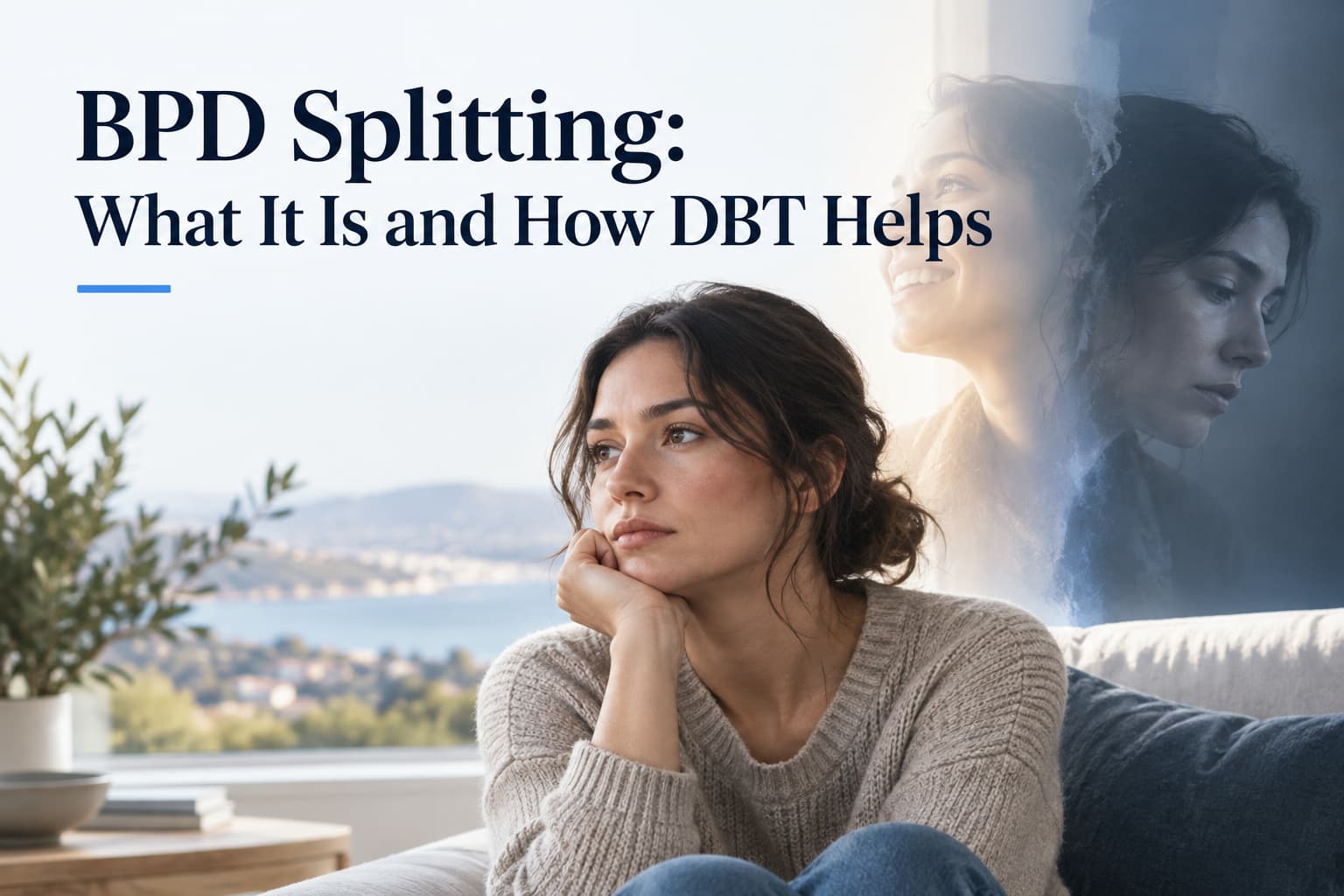
BPD splitting is the mind sorting a person or situation into all good or all bad, so someone you adored on Monday can feel like an enemy by Thursday. It's a pattern of black-and-white thinking tied to intense fear of rejection, and it can be treated. Dialectical behavior therapy (DBT) teaches specific skills that slow the swing before it takes over a relationship.
If you or someone you love is thinking about suicide or self-harm, call or text 988 right now.
How BPD splitting shows up in everyday relationships
Splitting usually looks like a sudden change in how someone talks about a person they were close to a day earlier. A partner who was "the only one who gets me" becomes "someone who never cared, " often after a small trigger like a late text, a canceled dinner, or a tone that sounded cold.
The same swing can land on a boss, a therapist, a friend, or a family member. It can also land on a situation. A job, a move, or a treatment plan gets called perfect one week and a total mistake the next.
Here are the signs people around them tend to notice:
- Words like "always, " "never, " "everyone, " and "no one" show up in the middle of a disagreement.
- Someone gets idealized fast, then dropped fast, sometimes with no clear event in between.
- A mild mistake gets treated as proof that the whole relationship was fake.
- Strong anger, panic, or shutdown appears quickly, then fades, and the person may feel confused or ashamed about it afterward.
From the outside, it can look like manipulation or drama. From the inside, it usually feels like plain fact. The person isn't choosing to see you as all bad. In that moment, their mind can't hold your kindness and your mistake at the same time.
Splitting is a feature of borderline personality disorder, but a single sharp argument doesn't mean someone has it. What points toward BPD is a repeating pattern across many relationships, tied to a fear of being abandoned. A clinical assessment is how that gets sorted out, and at Enhance in Tustin it's the first step before any level of care is recommended.
What sets off splitting and why it feels so real in the moment
Most episodes start with a perceived signal of rejection, and the signal doesn't have to be real. A slow reply, a change in plans, a friend who seems distracted, or a correction at work can all register as "they're leaving me." Stress, poor sleep, and substance use lower the threshold, so a comment that would have passed on a calm day lands hard on a bad one.
The reason it feels so real is that emotion arrives first and the reasoning follows to defend it. When fear of abandonment spikes, the brain's alarm system takes over, and the person's attention narrows to the threat. Memories of kind moments with you become hard to reach. Only the hurt is available, so the conclusion "you don't care" feels like observation, not interpretation.
That's also why arguing the facts rarely works mid-episode. Listing the times you showed up doesn't land, because the person can't access those memories right then. Clinicians tend to see better results when the other person lowers the intensity first and saves the discussion for when the person is calm.
A few things are worth tracking, because they make the pattern visible and give a therapist something concrete to work with:
- 1What happened in the hour before the shift, including small events.
- 2What the person told themselves about it ("they're done with me").
- 3How the body felt, such as a racing heart, heat, or numbness.
- 4How long it took to ease and what helped.
Written down over a few weeks, these notes often show that the same kinds of triggers repeat. That's the material DBT works with, and it's what an assessment with the Tustin team at 14742 Newport Ave would build on.
How DBT skills interrupt a splitting episode
The first DBT skills people use mid-episode are physical, because a racing heart has to settle before any thinking can change. Distress tolerance skills such as cold water on the face, paced breathing with a longer exhale, or a brisk walk bring the body's alarm down. Once the intensity drops, the mind can reach the memories that were blocked a few minutes earlier.
Next comes "check the facts, " an emotion regulation skill. The person writes down what actually happened, what story they attached to it, and whether the evidence supports that story. "She didn't text back" and "she's done with me" get separated onto two lines. Many people find the gap between them is bigger than it felt.
Then there's the skill DBT is named for, dialectical thinking, which means holding two true things at once. "I'm hurt by what you said" and "I still trust you" can both stand. Practicing that sentence structure is a direct counter to all-or-nothing thinking, and therapists coach it until it comes more naturally.
Interpersonal effectiveness skills handle what comes after. Instead of sending a message that ends the relationship, the person learns to state the need plainly, ask for reassurance, or take a break and return to the conversation.
You'll practice these in skills groups and individual sessions, and you'll usually get homework, such as logging which skill you tried and how it went. Early on, expect to use them after an episode. With repetition, they move earlier in the swing. Therapists at Enhance, which holds Joint Commission accreditation, build this work into personality disorder treatment after an assessment.
Supporting someone who splits without taking the swings personally
When your person turns on you mid-conversation, the most useful move is to lower the volume instead of defending yourself. Speak slowly, keep your sentences short, and skip the rebuttal. "I can see you're hurting, and I'm not going anywhere" does more in that moment than a list of everything you've done for them.
Once the intensity drops, hours later or the next day, you can talk about what happened. Start with what you heard ("It sounded like you felt dropped when I canceled") before you explain your side. People who split often feel deep shame afterward, so a calm, specific conversation helps them more than a pointed "we need to talk about last night."
Boundaries are part of support. You can stay kind and still refuse to be called names, and you can say so once, plainly: "I'll step out and come back in twenty minutes, and we'll pick this up then." Then follow through by actually coming back. Predictability is what builds trust with someone who fears abandonment, and it keeps you from burning out.
Learn the skills they're learning. If your person is in DBT, ask which skill they want you to prompt, such as paced breathing or checking the facts, and agree on a word or phrase ahead of time so the prompt doesn't sound like criticism. Many families also benefit from their own support, and a therapist can help you sort out which behaviors to respond to and which to let pass. If your person is in treatment at Enhance, ask the Tustin team whether a family session fits their plan.
You're also allowed to take care of yourself. Absorbing every swing without rest wears down the relationship faster than a pause does.
Which level of DBT care fits: outpatient, IOP or PHP
The right level depends on how often splitting episodes turn into crises and how much structure your home life can hold between sessions. A clinical assessment sets the recommendation, and the team explains how they reached it.
Outpatient DBT fits when episodes happen but you're still keeping up with work, school, and relationships. You attend individual therapy and a skills group, then practice on your own. Enhance offers outpatient by video through virtualtreatmentcenter.com, which helps if commuting is the barrier.
An intensive outpatient program (IOP) makes sense when weekly sessions aren't enough to keep pace with the swings. Signs include repeated blowups that end relationships or jobs, skills you understand but can't reach in the moment, or episodes that leave you in crisis several times a month. IOP puts more skills practice and more clinician contact into your week while you sleep at home.
A partial hospitalization program (PHP) in Tustin is the most structured option that still lets you go home at night. It fits when episodes have become frequent or severe, when self-harm urges keep returning, or when you've stepped down from a higher level of care and need a firm landing. If home is unsafe or you can't stay safe on your own, a residential or inpatient setting may be the better fit. Mental health inpatient care takes place at Eden by Enhance (edenbyenhance.com), a sister facility run by the same people, and Enhance admissions is still your first call.
Levels aren't permanent. Many people start at one and move up or down as skills take hold, and the team reviews that with you along the way.
Insurance is worth sorting out early, because benefits vary by plan. Admissions verifies yours and explains which level your plan may cover.
What happens when you call Enhance admissions
The person who picks up at (714) 862-1907 is on the Tustin admissions team, and the first few minutes are mostly questions. They'll ask what's been happening, how long it's been going on, if you're safe right now, and if you've had treatment before. You don't need a diagnosis or a polished summary. Saying "I switch on people I love and I can't stop it" is enough to begin.
It helps to have a few things nearby:
Your insurance card, or the member ID and plan name.
A short list of current medications, if you take any.
Any past diagnoses or treatment, even if you're unsure of the details.
The notes on triggers you've been keeping, if you have them.
If you're calling for a family member, the team can talk through what you're seeing and what the next step looks like. The person who'll be in treatment will need to take part in the assessment itself.
While you're on the phone, admissions contacts your insurance company, then explains your deductible, your copay, and which level of care your plan may cover. Benefits vary by plan, so the answer is specific to you. You'll also hear what the clinical assessment involves, since that conversation, not the phone call, determines whether outpatient, IOP, or PHP fits.
You can ask anything that's been holding you back, such as how DBT groups work or whether a partner can join family sessions. Calling doesn't commit you to anything. If you'd rather start with the paperwork, the insurance form online reaches the same team.
Call (714) 862-1907, or use the Verify insurance button below, and ask the Tustin team to check your benefits.